Sunday, May 27, 2012

Fighting Organizational Complacency


NOTE:  This blog is moving.  Please read future posts at: http://leadingtransformation.wordpress.com

Applying lean requires a significant shift in thinking for most of us.  One aspect that I have found to be particularly difficult for people is the notion that anything less than perfection is acceptable. There seems to be a natural tendency to accept that things are good enough - and when people in the organization reach this point, complacency sets in and the improvement process begins to die.

One of the warning signs of organizational complacency is a passive resistance that shows up in statements like, "we can always improve, but . . . "  The "but" is the tip off that a person does not truly feel things can get much better.

Believing Your Own Press

Over and over again, I have seen periods of significant improvement followed by a return to mediocrity fueled by a belief that the most significant problems facing the organization have been solved and further improvement is not necessary.  In one instance, I worked with an organization that, over a period of several years, achieved marked improvement in product quality while increasing inventory turnover fivefold.  As the company became recognized as the industry leader, however, arrogance began to creep into its culture - which was not surprising given the remarkable turnaround that occurred during the previous period.

As is often the case, the arrogance was accompanied by complacency, and signified that people were satisfied with the current level of performance.  Within two years, the company's improvement efforts stagnated as inventory levels increased, quality declined, and profitability suffered.  The CEO who led the company during the period of growth (and was since promoted to a higher position within the parent company) returned to the organization to re-establish a continual improvement mindset.  After several years, humility and a drive for perfection began to return to the culture.

Some of the articles on the problems faced by Toyota a few years back point to organizational complacency as a potential cause.  Although much of the accelerator issue was eventually blamed on driver error, the company's rise to number one in such a short period of time, along with the significant increase in stock price, caused a loss of focus and made it difficult to maintain the motivation to improve.  Recognizing this as a problem, Akio Toyoda has said on several occasions that the company's future success requires a return to the basics - something that, at least from the outside, it seems to be working.

Perfection is the Only Acceptable Result

People in companies that appear to sustain the process over long periods of time tend to exhibit an obsession with improvement.  The drive to improve is integrated to the point where any resistance to change is quickly identified and repressed to prevent it from creeping into the culture.

As written in a previous blog (link), the notion behind the use of the term countermeasures rather than solutions is meant to keep anyone from thinking that there is an end to improvement efforts.  When the goal is perfection, there can be no such thing as a “solution” to a problem.

Continually striving for perfection can be tiring, so it is important to celebrate successes along the way.  While recognizing achievements, however, it is important that everyone understand that achieving and sustaining success requires never letting go of the idea that perfection is the only acceptable result for the company.  And a culture that continually strives for perfection has no room for the word, “but.”

Sunday, May 13, 2012

Batching or Single-Piece Flow?

NOTE:  This blog is moving!  Please read future posts at http://leadingtransformation.wordpress.com

One critical aspect of lean thinking that many people have trouble grasping is the importance of moving from batching to single-piece flow.  After all, if improving productivity is one of the things we're ultimately trying to achieve, isn't batching the most logical choice?

WHY WE THINK BATCHING MAKES SENSE

If we're striving for higher efficiencies within an individual step of an operation without regard for the effect on the overall process, then batching tends to make sense.  In fact, batching is a common practice in so many organizations today because of a fragmented approach to setting goals that forces people to maintain an inward focus to improvement.

When following a systems thinking mindset, on the other hand, it becomes clear that local ideas for improvement need to be evaluated - before they are implemented - as to whether or not they result in improvement to the organization.  And in the end, isn't organizational improvement what we're ultimately after?

Although batching often appears more efficient than single-piece flow for an individual task, the practice tends to create waste for other parts of the organization that more than offset the perceived benefits.  Some of the wastes that result from batching include:
  • increasing the time between spending money in a process and receiving money from customers due to an increased overall cycle time and inventory that is not yet sold;
  • waiting and downtime in one or more steps of the process while previous steps complete work on multiple units;
  • larger amounts of inventory between process steps to reduce the likelihood that one step will shut down while waiting for a previous step to complete a batch;
  • increased rework and delays when a defect is discovered that affects an entire batch of work rather than a single unit;
  • increasing the time required to implement a design improvement because of the need to use up a larger  amount of inventory.
A dilemma commonly associated with a batching mindset is determining the the optimum batch sizes.  It is very likely that the "best" quantity to run for each step in the process will differ, resulting in further increases in inventory throughout the system.

IS SINGLE-PIECE FLOW ALWAYS POSSIBLE?

There are situations where batching is more cost effective because of limitations resulting from tooling, equipment, technology, or process design.  Although producing work in batches under these circumstances may be the most logical and cost-effective choice today, it should never be considered acceptable into the future. Batching must be considered a countermeasure until the process can be improved to the point where single-piece flow (or smaller batches) can occur.

Whether applying lean to a manufacturing process, administrative operation, or drilling gas wells, it is important to understand the effect that batching has on process flow, operating costs, and overall competitiveness of the organization.  To do this requires a systems thinking mindset, as well as a deep understanding of the process and the needs of the customer.

As long as people are evaluated on objectives that are not carefully aligned throughout the organization or do not clearly support high-level objectives, batching will appear to be preferable to single-piece flow.  Like many other aspects of lean thinking, trying to move to single-piece flow before transformation of leadership has occurred will most likely result in frustration among team members and disappointing results for the organization.

Saturday, May 5, 2012

Lean Success? Not Without Patience

This blog is moving!  Please read future posts at http://leadingtransformation.wordpress.com 

It's no secret that virtually all lean deployments fail to achieve intended results. One of the main reasons for this is a lack of patience in the time and effort required for transformation.  Success with lean requires a long term commitment to learning, consistent focus, and patience.  If the company's leaders are not in it for the long-haul, it's probably best not to start the journey.

The Cambridge Dictionary of American English defines patience as the ability to accept delay, suffering, or annoyance without complaining or becoming angry.  When applied to business business, patience refers to the ability to accept delays, setbacks, and periods of doubt without abandoning a chosen direction.  Although there will be benefits along the way that will make many people feel good about progress, there will also be bumps in the road that will make some question whether lean is worth the effort.

Make no mistake that a company will never be "lean." The best you can hope for is to get to the point where continual learning and improvement become so engrained in the culture that lean thinking does not appear to be anything out of the ordinary.  There will always be a need for coaches and commitment to maintaining - even staunchly protecting - the culture because the natural tendency for things to return to the "old way" will never go away.

It may seem strange that the road to continual and rapid improvement requires patience but it's true.  And unfortunately, patience is one characteristic that is sorely missing in Western business.

Sunday, April 29, 2012

Lean is NOT Common Sense

This blog is moving . . . please read future posts at http://leadingtransformation.wordpress.com.

How many times have you heard that lean is “just common sense?”  Over the years, I’ve noticed that those who say this are generally the ones who resist lean the most.  Referring to lean as nothing more than common sense is often an excuse to ignore transformation and continue to do things in the same way.
Depending on your frame of reference, common sense can tell you to:
  • build inventory to handle changes in demand or chronically late deliveries;
  • set individual goals for people (and tie closely to bonuses and performance reviews) in order to improve performance;
  • run large batches to deal with long setup times and continued stockouts;
  • reduce costs by pressuring suppliers to drop prices;
  • address problems by looking for solutions rather than countermeasures
Lean is a very different way of thinking for most people and requires significant transformation of individuals and the organization in order to be successful.  Before this transformation begins to occur, many aspects of lean thinking will actually appear counter to common sense.  Do not let anyone hide behind the “common sense” shield during the transformation.

Sunday, April 22, 2012

The Effect of Structure on Performance

NOTE:  This blog is moving!  Please read future posts at http://leadingtransformation.wordpress.com 

No one component may seek its own reward without destroying the balance of the system. Each component is obligated to contribute its best to the system as a whole. – W. Edwards Deming

What effect does an organization’s structure have on the ability to be successful?  For years, western business has clung to the notion that a functional organization is the most beneficial, but what effect does this really have on overall performance?

Doesn't the performance of the organization as a whole matter more than the performance of any individual area?  If so, is there a correlation between the two?  If individual functions optimize their own performance, does this automatically improve performance of the larger organization?

A SYSTEMS THINKING PERSPECTIVE

Lean requires a systems thinking mindset; meaning that the success of an individual function is determined by the contribution it makes to the organization.  Over an over again, I have seen examples in functionally-structured companies where individual areas - intentionally or unintentionally - focus on their own goals with little or no regard to the effect they have on other areas.

This tendency toward functionally-focused goals, which is common in western business, is a significant contributor to the construction of silos within the organization that are difficult, if not impossible, to break down without a drastic change in leadership and culture.

The alternative is a process-oriented structure that drives people to focus on the performance of the system rather than an individual area.  Each person uses his or her own special knowledge and skill to optimize the system; and rewards are based on the overall performance of the system.

The common argument against moving from a functional to a value stream (or process-oriented) structure is that sharing between specialists and improvement within the functions will cease to occur.  Although it is possible for this to happen, it is not a strong enough reason to remain in a functional structure.  Systems can  be created to assure that learning and sharing of information within functions occurs.  Since people tend to be inherently interested in their areas of specialization, assuring function-focused learning systems are effective is most likely easier than getting the various functions work effectively with each other to achieve organizational goals.

I have worked with organizations over the years that wanted to deploy lean thinking but were afraid to let go of a functionally-oriented structure.  In these instances, the functional pull toward individual goals and rewards had generally won out over the drive to optimize the organization and led to sub-optimal results.

I once worked with a manufacturing company where the supply chain team directly supported operations by procuring materials used on the production line.  On-time delivery performance for one particular factory was consistently around 60%, which negatively impacted customer satisfaction.  According to operations data, roughly 75% of late deliveries were attributed to material shortages.

Since the product produced within this factory was strategically critical for the company, team members within operations felt significant pressure to improve performance.   Although supply chain team members also felt pressure to improve delivery performance, they reported to a corporate function separate from operations and were primarily driven to reduce material and inventory costs rather than improve delivery.

Because of the situation, delivery performance continued to suffer, motivation was low, stress levels were high, teamwork suffered, and employee turnover increased.  Although from the outside this problem seemed easy to remedy, organizational politics and the natural tendency to cling to a functional organization (i.e., the we've-always-done-it-that-way syndrome) prevented the shift to a process-oriented structure.


Organizational transformation cannot occur without transformation of thought.  Everything that is known must be questioned to determine whether or not it helps the organization move toward its vision.  In most cases, without a significant reduction in the white space between teams, functions, and locations, the ability to sustain any improvement in performance will be difficult, if not impossible.

Sunday, April 15, 2012

What is Lean Six Sigma And Why Is It Necessary?

This blog is moving!  Please read future posts at http://leadingtransformation.wordpress.com

Several years ago, the term Lean Six Sigma (LSS) appeared on the scene and since then, countless books, seminars, and conferences have popped up referencing the term.  I’ve read books and articles on the subject but continue to have trouble understanding the distinction between LSS and just plain lean.

I've had people tell me that lean is about attacking waste; six sigma is about reducing variation; and LSS combines the two into a complete approach that is more effective than either by itself.  Sorry, but this explanation still does not convince me that LSS adds anything besides confusion.

I have never seen an effective lean deployment – before or after the advent of LSS – that did not include a focus on reducing variation.  Variation causes waste and interferes with flow and, because of this, must be addressed as a critical element to improvement efforts.

W. Edwards Deming wrote extensively about the importance of reducing variation, and Genichi Taguchi based his methods on minimizing variability.  Both Deming and Taguchi heavily influenced Toyota and were integral to the development of TPS and lean.

If we want people to take lean seriously and truly buy into the approach, we have got to be consistent with the message.  Rebranding lean and presenting it as something different risks turning it into just another business fad – which, for the sake of Western business, is something we cannot afford to let happen.

Saturday, April 7, 2012

Using Countermeasures - Not Solutions - To Address Problems

NOTE:  This blog is moving!  Please read future posts at http://leadingtransformation.wordpress.com 


One element of the Toyota Production System that has not gained much attention is the practice of addressing problems with countermeasures instead of solutions.  Although seemingly nothing more than an issue of semantics, I find the focus on countermeasures versus solutions rather significant.

Solutions Thinking

One of the common misunderstandings many people have about six sigma or kaizen is the idea that the tools will lead to the development of a solution to the root cause of a problem.  Organizations are highly complex systems and it is naive to think that any of the problems they face result from a single root cause or can be resolved by a single solution.

When all of the factors and interactions that can influence work are understood, it becomes clear that the best we can do is attack problems by addressing as many of the perceived causes as possible with the idea that we may never permanently fix the issue.  Because of this, remaining competitive requires continually developing and implementing measures to improve processes and accept the fact that some of the problems the organization faces may never completely disappear.

This is a difficult concept for many to accept because of the importance our culture places on solving problems.  Countermeasures can, at first glance, appear to be nothing more than temporary fixes to problems rather than permanent solutions - which is counter to what organizations are trying to achieve with lean.  In reality though, it is just the opposite, because a solutions thinking mindset can give a false sense of security that a particular problem has, in fact, been eliminated.  This can be very dangerous down the road if a problem that the team thinks it resolved returns.

This is not to say that a countermeasure approach focuses on symptoms of a problem rather than the root causes.  The tools and methods associated with an effective kaizen process help a team get down to the root causes of a problem.  The difference with this line of thinking, however, is the concept that there are several potential root causes to any problem and that actions taken to address a problem are based on what is known today with whatever information is currently available.  As the environment changes, the problem can reappear as a result of new or different interactions that were not known at the time it was last studied.  Although the initial countermeasures were valuable to the company, the team needs to continue its efforts to assure performance remains stable or continues to improve.

The Learning Organization

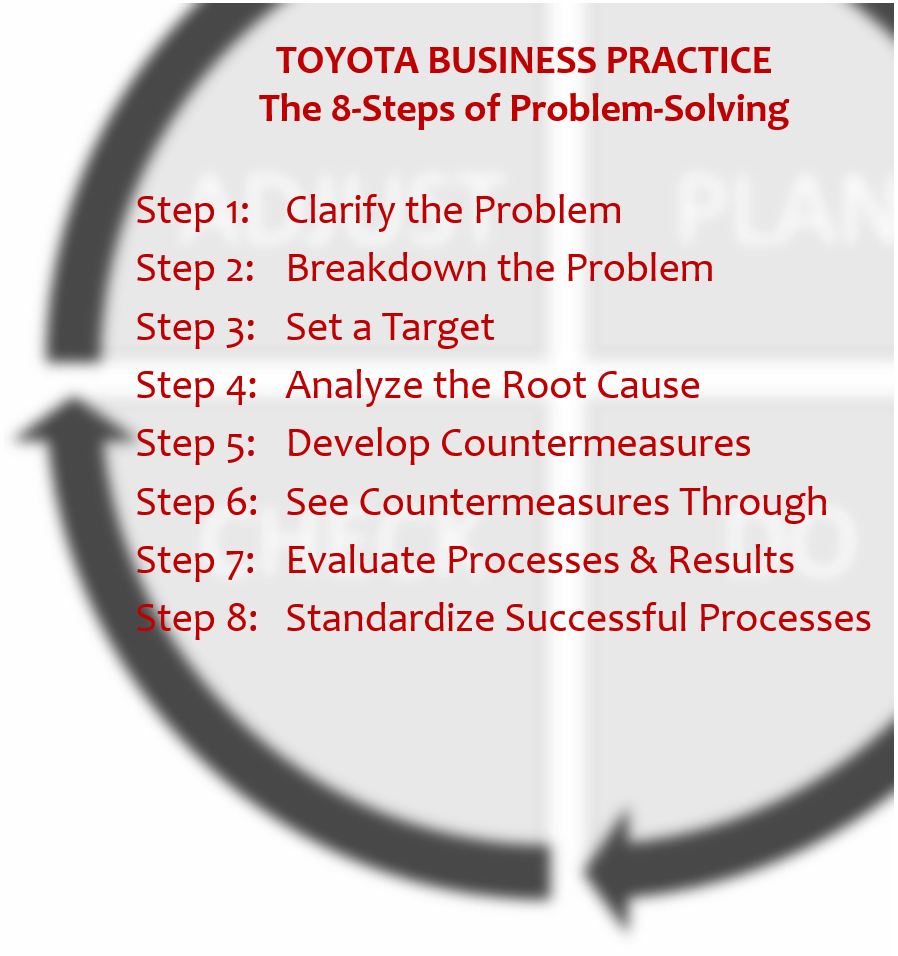
Another significant advantage of a countermeasure approach is the amount of learning that takes place within the team.  Rather than studying the problem, developing a solution, and moving on, the team moves around the PDCA cycle many times as it continues to address root causes with more and better countermeasures.  With each trip around the cycle, the team learns more about the process and the interactions where problems can occur.  As a result of continuing to develop and test hypotheses, team members truly become experts about the processes with which they work.

A Cultural Transformation

One of the critical challenges of lean thinking is changing the organization’s culture so people get the idea that continual improvement is not only possible, but necessary for survival.  Talking in terms of solutions, however, can actually interfere with this type of transformation.

In the most basic sense, the term countermeasure refers to action(s) taken in response to a problem, whereas a solution implies achieving a state where a problem has been eliminated.  [See definitions] Note that the term countermeasure makes no reference to solving a problem.

When the team starts referring to improvements as countermeasures instead of solutions, the culture starts to change.  People begin to believe that problems may never be completely solved and understand the need to continually strengthen processes.   Improvements are celebrated, but only as temporary steps toward the ultimate, albeit unattainable goal of perfection.

Starting at the Top

Adopting a countermeasure mindset within the organization requires a good deal of clarity and consistency from leaders.  There will be frequent opportunities to coach team members on a new way to look at and address problems.  As with any type of culture shift, however, there will be a good deal of inertia pulling the team back to old – and more comfortable - ways of thinking.  Because of this, it is critical that leaders apply relevant countermeasures when progress has slowed.  Like mountain climbing, organizational transformation can take significant time and effort to make a small amount of progress; while any lapse in focus can result in a fairly quick decline.