Wednesday, January 2, 2013

2012 Annual Management Blog Roundup - John Shook & the Lean Enterprise Institute


This is the second installment of my favorite management blogs as part of John Hunter’s 2012 Curious Cat Management Blog Carnival.


John Shook is one of the most recognized names in lean thinking.  John spent 11 years at Toyota, and has authored (or co-authored) several books on the Toyota Production System.  He is currently Chairman and CEO of the Lean Enterprise Institute (www.lean.org) and maintains a blog on the site entitled John Schook’s eLetters, where he has been posting since 2008.

In Encouraging Signs of Leadership, John addresses the complexities of leading a lean journey.  An organization is a system and transformation needs to take place on many dimensions.  Change must be driven on the system, not the components of the system.

In the post, Shook writes that, “Leadership is integrated into the work and not overlaid onto it.  And yet many prevailing conceptions of leadership fail to grasp this simple but essential truth.”
In another post (Learning Lean – Collaboratively), Shook writes on my favorite lean topic: learning.  Lean practitioners are obsessed with learning but, as Shook writes, learning does not happen just because one wants it to.  It results from the application of tools and methods that enable a PDCA mindset.  Through PDCA, mechanisms like standardized work, kata, kaizen, and hoshin kanri all enable learning to occur faster.

In So What Are You Going To Do About It? (I love the title) Shook addresses the changes taking place in the world and the resulting impact they are having on business.  By once again returning to the idea of appreciating the system, he talks about the importance of understanding and improving the value stream as the way to deal with these large-scale changes.  By addressing problems in isolation, we’re doing nothing more than pushing costs from one part of the value stream to another.

W. Edwards Deming used to say that the system is as large as we’re able to manage.  I think the complexities and interactions in today’s world require us to see the system as much larger than was required in years past.  Understanding the supply chain, company processes, distribution, and customer tiers, although complex, is necessary for the long-term success of any organization.
 
Although Shook tends to push products and services of the Lean Enterprise Institute in many of his blogs, one can gain a wealth of information by merely reading and reflecting on his posts.  Focused directly on the application of lean, the influence of Deming is very evident. 

Additional information about the Curious Cat Annual Management Blog Carnival is available at http://management.curiouscatblog.net/category/carnival/.

Monday, December 24, 2012

Blog Carnival 2012 - Peter Drucker's Management Philosophy


One of my favorite blogs on leadership is John Hunter’s Curious Cat Management Improvement Connections.  Besides a number of informative posts on a variety of improvement-related topics, John regularly hosts a management blog carnival, where various business and leadership blogs are featured.

This year, I’m happy to participate in the carnival with information on some of the blogs I read on a regular basis.  Reviews of all of the blogs featured in this year’s carnival can be found at http://curiouscat.com/management/carnival_2012.cfm. 

My first review in this year’s carnival is Peter Drucker’s Management Philosophy by Jorrian Gelink.  I don’t know Jorrian personally, but after reading his blog, he is obviously a Drucker zealot with excellent insight into Peter Drucker’s management philosophy.

Peter Drucker’s teachings are closely aligned with a lean mindset.  I have always found the information he provided to be a great fit with W. Edwards Deming’s System of Profound Knowledge, and a necessary component of effective leadership.  Although Deming regularly attacked Management by Objectives (MBO), I believe he was more disappointed with how MBO was implemented than the method itself.  In fact, Drucker even said that MBO only works if objectives are carefully thought through, and that 90% of the time, they aren’t.

I believe much of Drucker’s teachings have been lost over the last several years, as companies look for quick and easy ways to “become lean.”  I applaud Gelink for keeping it alive and using it to teach current and future leaders that Drucker’s philosophy is as relevant today as it was when he was alive.  I enjoy reading Gelink’s posts and expect to continue to learn from the Peter Drucker’s Management Philosophy in the future.

Gelink organizes the blog into four main sections:  Executive Basics, Management Basics, People Management, and Entrepreneurship.  There is also an excellent search tool that makes it easy to find posts on a number of management topics.  A sample of Jorrian’s posts is listed below:

Fear of Conflict – Why Conflict is Necessary  An excellent summary of the benefits of healthy conflict in any organization.  The post reminds me of The Abliene Paradox by Jerry B. Harvey; a story where family members agree to drive 53 miles to Abilene for lunch, even though nobody really wants to do it.  To avoid conflict, however, they all go along, have a terrible time, and blame each other upon returning home.  Unfortunately, too many organizations suffer from the Abilene Paradox because of the absence of open, healthy conflict.

In the post, Jorrian writes, “the result of a stronger, discussed plan is increased effectiveness, and overall satisfaction of those involved because their input was considered into it.”

What is Our Mission?  The Heart of the Organization  Whether deploying lean or not, the importance of a clear and unchanging purpose is critical to success.  Without a clear mission, there is no team – there is only a group of individuals who define success on their own terms.  Any success without a consistent purpose is accidental and destined to be short-lived.

In providing direction for defining the purpose, Jorrian wrote, “the mission starts with what is on the outside of the organization; not with what is inside.  Entrepreneurs that fail are the ones that do what they want to do, instead of what their customer wants.”  Examples of mission statements from successful technology-based companies are provided within the post.

In Personal Development – Becoming Effective in Your Role, Jorrian provides the distinction between being effective and efficient, specifically that effectiveness results from doing the right things.

The post hits on one of Drucker’s most important teachings – the idea that understanding, developing, and continually using your strengths is what leads to success.  Jorrian writes that aligning individual strengths with the organization will lead to increased effectiveness and personal success.

I have so many interesting books on reading list that I will never have the time to complete.  As with Deming, I learn a great deal each time I re-read one of Drucker’s books because he had so much to teach.  Reading Peter Drucker’s Management Philosophy allows me to keep up on Drucker’s theories even when I don’t have the time to re-read his books.

More information on the 2012 Management Improvement Blog Review can be found at http://curiouscat.com/management/carnival_2012.cfm.  For specific posts from this year’s carnival, please go to http://management.curiouscatblog.net/category/carnival/.

Sunday, December 9, 2012

The Big Gains? Not Without Transformation

“In my experience, most troubles and most possibilities for improvement add up to proportions something like this:  94% belong to the system (the responsibility of management). . . No amount of care or skill in workmanship can overcome fundamental faults of the system.” – W. Edwards Deming

Why have so few organizations been truly successful with lean?  The philosophy has been around in one form or another for many years and there is no shortage of books, papers, and seminars on the subject.  Even with well-publicized examples like Toyota, Southwest Airlines, and Herman Miller, the probability that a lean deployment will succeed today is fairly low.

A major factor contributing to the problem I have found is that people tend to underestimate the transformation required to succeed.  When one learns about lean, there is a tendency to believe that teaching people how to identify and eliminate waste is the key to success.  Although there is a fairly good chance that improvement will occur after investing in training and coaching, without transformation the organization will never get beyond the initial stages of lean and never realize the big gains that can be achieved through its adoption.  The pace of improvement will eventually slow, and the resulting frustration and natural pull back to traditional thinking will eventually lead to abandoning the effort.

Transformation in Thinking

There is a point in the process where a significant transformation in thinking is needed to move the organization to the next level and achieve the big gains. Whether occurring at a single point or several points over time, transformation in thinking occurs when leaders begin to realize that the organization's problems are the result of barriers that only they can fix.  It is at this point when workers are no longer blamed for poor performance and the lack of improvement.
Improvement and the point of transformation
Although necessary for improvement, lower level kaizen activity can only take the organization's performance so far, while addressing issues like poor hiring and promotion systems, an unclear or inconsistent purpose, a lack of learning, ineffective planning, and other barriers are the way to tap into the 94% of the improvement opportunities available to the organization.

What causes a leader to transform his or her thinking depends on experiences, perspectives, and outlook for the future – and it’s different for everybody.  The key to success is to keep working with people until they realize lean is a very different approach to business.  It requires a dedication to lifelong learning and change, and the understanding that the inertia associated with the traditional approach to business will cause a continual pull within the organization back to its old ways.

Sunday, December 2, 2012

Where are the Generalists?


"[Management is] an integrating discipline of human values and conduct, of social order and intellectual inquiry, [a discipline that] feeds off economics, psychology, mathematics, political theory, history, and philosophy. In short, management is a liberal art..." - Peter Drucker


Businesses need specialists in order to be successful – this is nothing new or earth shattering.  Having people with specialized knowledge in areas related to the company's products, services, processes, network infrastructure, etc. enable the ability to serve customers and meet objectives on a continuing basis.  What many people do not realize, however, is that having generalists – especially in leadership positions – is just as critical to the organization’s success.

What is a Generalist?

A generalist is someone who has broad knowledge and skills, and understands the organization's high level system, including the hand-offs and interactions between people and processes.  A generalist is not usually interested in working and developing his or her skills within a single area but is more motivated to learning more about the big picture.  He or she is much more comfortable learning a little about many subjects than learning a lot about a single subject.

An organization can have the most talented specialists in the industry but be completely ineffective if these people are not able to agree on what's important and work together to turn their combined talents into commercial success.  By understanding the system, the generalist can bring value to the organization by focusing on overall company performance rather than attempting to optimize any single function or area.  For this reason, generalists often excel in leadership positions and cross-functional roles like project management and planning.

Why Generalists Are Necessary

By clearly understanding the company's high level value stream, the generalist is able to continually align the objectives in one area to those of the organization.

No matter how talented a company’s specialists are; without a common direction and continual effort to improve the way people interact and work together, there is no "organization" - there are only individuals working on what each feels is most important.

Peter Drucker wrote that management is a liberal art in that it requires skill from many different disciplines including psychology, sociology, history, and others.  W. Edwards Deming included psychology, learning, variation, and systems thinking as components of leadership in his System of Profound Knowledge.  What Deming and Drucker were referring to was that management is a role for generalists.

Harnessing the Company's Talent

The obsession many companies have had with specialists over the last several years has created a shortage of generalists that is hampering growth and success.  As a result, many companies are full of great ideas, new technologies, and brilliant technical minds but aren't able to transform them into consistent commercial successful.  A company may be staffed with highly skilled scientists, engineers, and chemists, but if it is not turning this knowledge into viable products or services, it is compromising its future.

Whenever hiring or promoting someone into a leadership position, I have found that a person with a varied background tends to be more effective than someone whose experience and training is completely focused on the function the person is expected to lead.  For example, I would tend to favor a candidate for a quality management position who has experience in procurement and/or manufacturing in addition to quality than one who only has quality control or quality assurance experience.

It's in the Mix

Success in business requires having and leading people to consistently achieve high level objectives.  To do this successfully requires respecting the different talents people have and understanding how best to position and organizing everyone to serve the customer effectively.  This means having the right mix of generalists and specialists to assure success.

Sunday, November 25, 2012

Deming and Lean

I’ve read a lot of books and papers over the years that, in one way or another, touch on the subject of lean, and very few made the connection with the teachings of W. Edwards Deming.  Besides the fact that Deming had a huge impact on Toyota over the years, I don’t think it is possible to truly appreciate lean without a basic understanding of his philosophy on management.

I’ve included some quotes from Deming in this post to help demonstrate how his views on leadership and organizations helped form the foundation of the Toyota Production System.  Although one of the objectives of lean is simplicity, the methodology can be very complex, requiring a level of understanding of organizational behavior that I don’t think many people truly appreciate.  Success requires a continuing commitment to learn about the theories upon which lean was built in order to understand and deal with the specific situations, relationships, and interactions that make up an organization.  The more you understand the what and why of lean, the more effective you will be with the how during the deployment.

Deming would never tell anyone how to implement his theories – in fact, he would become visibly frustrated whenever anyone asked him about specific situations.  Like every great teacher, Deming would provide enough guidance to make one think and learn.  As it turned out, Deming’s theory of management provided the what and leaders at Toyota, Canon, and other companies used to develop the how.
_______________________

“The average American worker has 50 interruptions a day, of which seventy percent have nothing to do with work.”


The above statement covers the concepts of flow of work and value.  Without a clear and consistent understanding of the value provided by the organization, there is no way to know what has to “do with work” and what doesn’t.

“The emphasis should be on why we do a job.”

To prevent waste and guide improvement within an operation, those doing the work must understand value associated with the work.  Deming commonly used the example of cleaning a table to clarify the concept of operational definitions.  How can the person cleaning the table understand the level of quality required without first understanding why they are performing the job in the first place.  If the table is to be used as a workbench, it would require a different level of cleanliness as a lunch table, which is different from an operating room table.  The “why” provides direction for identifying and reducing waste within the work.

“When a system is stable, telling a worker about mistakes is only tampering.”

A stable system is one where the level of variation is predictable.  Improvement of a stable system requires management action.  Pressuring workers to improve quality in a stable system will lead to frustration, stress, and most likely lower quality.  This is a commonly forgotten concept in the kaizen process.

"Everybody here has a customer. And if he doesn't know who it is and what constitutes the needs of the customer...then he does not understand his job."

A statement on internal customers and systems thinking.  A change in one area of the process, regardless of the impact on that particular area, is not an improvement if it negatively impacts the system as a whole.  Without understanding the system, it is not possible to clearly understand how each area supports the others.

“Experience without theory teaches nothing”

The Plan-Do-Study-Act (PDSA) cycle is central to lean and continual improvement – and a central theme to the cycle, which many people do not understand, is the need to clearly state a hypothesis to test.  Learning, which is critical to the success of a business, occurs through testing a hypothesis and studying the results.

“It is not enough to do your best; you must know what to do, then do your best.”

A business must know its purpose (including mission and vision) and continually connect its activities with the purpose.  The business planning process consists of deploying strategies that will continually move the organization closer to its purpose.  Attempting to improve activities that are not aligned with the purpose – something that is unfortunately all too common in business – is waste.  In lean terms, the “what to do” are the value-added activities.

“All anyone asks for is a chance to work with pride.”

One of the principles of the Toyota Production System is respect for people.  Allowing (and sometimes rewarding) non-value-added work to occur shows a lack of respect for people.  Generally, people come to work motivated and ready to contribute to the organization’s success.  Loss of motivation, mistakes, and high turnover result from management issues and, if these become a problem for the organization, it is up to the leaders to look at themselves to understand the reasons and make corrections.

“Any manager can do well in an expanding market.”

This is closely related to the “experience without theory” statement.  If leaders do not have a theory to explain an increase in performance, there is no guarantee that the success will continue.  The true test of management ability is during a downturn because that is where the organization’s weaknesses will show up.

“Learning is not compulsory . . . neither is survival.”

Lean is about striving for absolute perfection.  Although perfection is something that is impossible to ever achieve or sustain it is nevertheless the focus of continually improving.  Continual improvement requires continual learning as markets, suppliers, customers, technology, and the overall environment changes – and learning does not happen by accident.  It is the result of driving the PDSA cycle into the organization’s culture.

Understanding the Foundation for Lean

This post could go on and on with additional quotes from Deming that help build the foundation upon which to build a lean mindset.  The objective here was to make the connection and stimulate further learning in Deming’s system of management because I truly believe that doing so will lead to a stronger and more sustainable transformation of the organization.

Sunday, November 18, 2012

How Well Do You Know Your System?

“If you can’t describe what you’re doing as a process, you don’t know what you’re doing.” – W. Edwards Deming

As a leader, how well do you understand how your organization works?  Do you have a good picture of the relationships and interconnections that exist both inside and outside that enable the company to operate?  I’m not sure it’s possible to truly grasp all of the complexities within an operation, but the more a leader understands about the overall system, the more effective improvement efforts will be to reduce waste and improve performance.

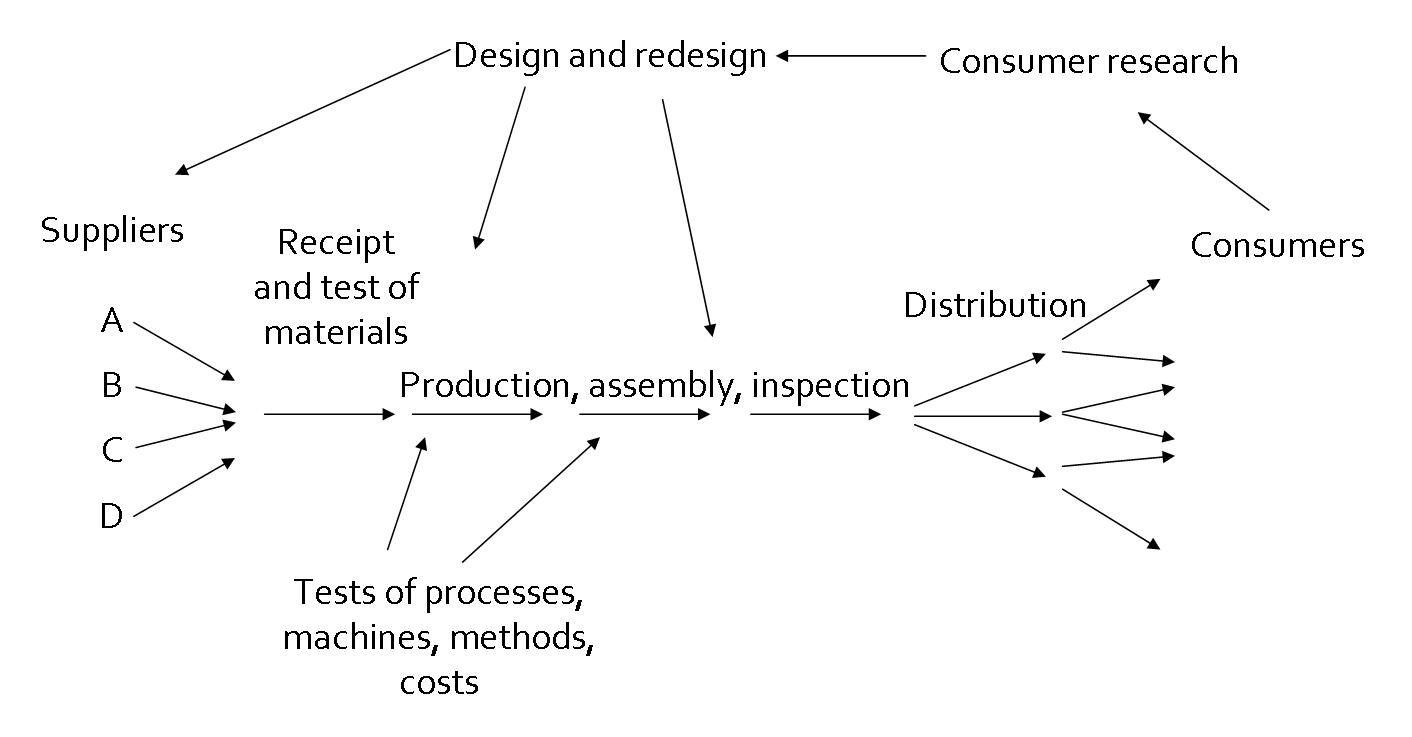
W. Edwards Deming wrote about the importance of understanding the system in Out of the Crisis and The New Economics, and what it means to leadership and transformation.  At first glance, it’s easy to miss the significance of the message Deming was trying to convey because of the assumed simplicity of the system diagram he referred to so often.  A common response after first seeing the diagram is, of course an organization consists of processes working together to produce a product or service . . . so what?
Deming's Production Viewed as a System (Out of the Crisis)

Other important aspects of leadership that become evident when systems thinking begins to take hold include:
  • the importance of flow to the success of the organization, as well as some of the areas that impede flow the most;
  • how individual functions tend to work against, rather than with, each other within the system, and how detrimental it is to serving customers;
  • the importance of internal customers and suppliers and how critical it is to improving quality and productivity;
  • a better comprehension of all of the organization’s stakeholders and why they matter to overall success;
  • a much clearer picture of what adds value to the overall system and what does not.
Organizations are in a constant state of change and, although it is not possible to completely understand all of the interrelationships that exist, it is important to appreciate how critical continually improving the interactions is to overall performance.  It also becomes evident that promoting leaders who have this level of appreciation and never stop attempting to learn about and improve the system is important to the company’s long-term success.

Sunday, November 11, 2012

Using ORID to Guide Business Planning


Having worked with many teams over the years utilizing A3s to deploy strategies, I am always looking for ways to make the process clearer and more logical.  As with any type of learning, what helps one person connect the dots and better understand the process does not necessarily work with another.

I’ve noticed recently how well the hoshin A3 aligns with the ORID (Objective, Reflective, Interpretive, Decisional) method of questioning.  Based on the Socratic method of learning, ORID is a structured conversation focused on getting a team to arrive at decisions based on the information available.

The process starts with clarifying and understanding the information available, and through a series of questions, guides the team to make decisions based on reflection and interpretation of the information presented.  When applied to business planning, the decisions are the actions or projects to be implemented over the coming period.

Specifically, the ORID stages include the following:
  • Objective:  Covers the facts available to the team, including data and evidence related to the topic being discussed.  This stage requires avoiding personal feelings or opinions about the situation and keeps the discussion as objective as possible to calibrate the team’s understanding of the facts;
  • Reflective:  The team discusses how they feel about the facts.  This lets team members relate their personal feelings about the information available to the group, including how they feel about the team's performance in the current period (did things go well?  did they go as expected as expected?  could performance have been better? etc.);
  • Interpretive:  Focuses the team’s energy on interpreting what the facts mean to the organization or the problem at hand.  The interpretive questions move the team to begin identifying potential causes of the current situation or reasons why objectives were or were not achieved.  The output of this stage is a list of areas needing to be addressed to improve performance in the coming period;
  • Decisional:  Specific actions or plans based on the previous stages of discussion.  The actions are focused on addressing the problem(s) identified or developing the plan for the coming period.
The ORID technique can be fairly complex in that it requires a facilitator who can keep the team focused on a specific stage without letting the discussion bleed into the next area phase.  For example, it is perfectly natural for people to want to reflect and interpret the situation – or even make decisions - before the facts are clearly understood, and the facilitator must be able to keep the group focused on an objective review of the information before moving on to next phase (similar to Stephen Covey’s principle of seeking first to understand, then to be understood).


ORID and Business Planning
ORID questioning is perfectly aligned with the A3 for business planning.  As shown in the exhibit, the A3 generally follows the ORID process in moving a team from current year performance to an action plan for the coming period.  Sticking to the phases helps the team deploy strategy by clarifying the facts and building a plan based more on logical thinking than individual opinions and operationalizes a Plan-Do-Study-Act (PDSA) approach to improving performance.