Showing posts with label greg stocker. Show all posts

Sunday, September 9, 2018

Innovation: Without it, You're Not Doing Lean


There seems to be a common misconception that lean thinking and innovation somehow conflict with one another.  Many companies approach innovation as something completely separate from lean in order to prevent concepts like standardization and stability from stifling creativity.

This is unfortunate because innovation not only fits but is actually a significant part of a lean system.  Failure to integrate innovation into a lean journey will lead to missing out on many of the big gains that are possible with the strategy and hurting the organization’s long-term competitiveness.

THE CONCEPT OF IMPROVEMENT

At its most basic level, improvement consists of two elements: problem-solving and breakthroughs.  Problem-solving involves addressing a drop in performance with the objective of returning to the way things were before the problem occurred.  This is critically important for maintaining performance by increasing the stability of processes and systems.  Most organizations, however, stop their lean efforts there and fail to significantly improve because of a lack of attention to improving performance and raising the standard.  As important as stability is to performance, raising the standards to new levels are just as important to long-term competitiveness.

Breakthrough or kaizen thinking deals with this to continually drive the organization’s performance to new levels.  The successful application of kaizen into an organization requires the type of innovative thinking and creativity that many organizations are missing, have stifled in team members, or address completely separate from lean.

MANAGEMENT PROBLEM-SOLVING

Breakthrough can come from two sources: the vision and ideas from team members to make products better and work easier.  An effective vision provides direction regarding how the company wants to perform in the future to be successful.  It must be grounded in reality to some extent but also provide enough of a stretch to energize people to apply the creativity to make it happen.  From this perspective, a comparison of how the company currently performs and how it is expected to perform 5 or 10 years in the future should provide a gap that needs to be addressed through creative problem-solving, or breakthrough.  As a general rule, this should consume about 20% of the organization’s resources, and the closer to the customer or the company’s main business activities (i.e., the factory floor, service counter, wellhead, etc.), the more the focus on the other 80%, or operating and maintaining processes to meet performance targets, and conducting problem-solving when targets are missed.  It should be noted, though, that the needs of every organization are different and the split must be adjusted to fit individual situations.

Driving breakthroughs to close the gap to the vision is basically management problem-solving and is where leaders need to spend a significant portion of their time.  This is one of the many reasons why micromanagement of team members is damaging to an organization.  Besides the negative effects on motivation, micromanagement shows that a leader is not developing those on his or her team to handle day-to-day problem-solving in to free up the leader to focus improving the system.

CHANGING THINKING

Problem-solving and breakthrough both usually reprogramming in the way most people think.  The typical reaction to problem-solving is to immediately jump to the countermeasure.  This is often due to an overloaded schedule, the need to look smart, arrogance, or many other factors that are influenced by geographic and company culture.  The problem with this is that, without understanding the problem clearly, or determining the most likely root cause, the countermeasure can be incorrect and worsen the situation, or even if it does happen to work, the team misses a valuable opportunity to learn more about the product or process involved.

Reprogramming thinking to improving problem-solving requires developing the analytical skills to clarify the problem, break it down to determine when, where, and how often it happens, and using a structured way to discern the most likely root cause.  Basically, people need to learn to become detectives to determine what changed since the process was meeting the standard.

Breakthrough thinking requires developing innovative or creative thinking.  This involves developing the ability to clarify the need as the difference between current performance and what it needs to be to meet the new target (similar to problem-solving).  It also requires learning how to reflect and observe to see what is keeping performance from improving beyond its current level and teaching people to challenge their own assumptions to better understand whether they are real or perceived, and if they are blocking new ideas from being devekioed.  Breaking down the walls that protect one’s beliefs about the work is a key to increasing the flow of ideas and creativity.

Although improvements will occur throughout the journey, patience and a good deal of effort is required to develop problem-solving and breakthrough thinking because it involves reprogramming the way a person has likely thought and approached work for decades.

LEAN THINKING INVOLVES BOTH

As an organization is undergoing a transformation toward lean thinking, it is critical to think about the whole system, which includes closing gaps to the standard as well as raising the standard.  Considering problem-solving only and keeping innovation separate from the effort tells people to that their ideas are not valued and to only focus on getting processes to operate to current standards. 

Integrating the creativity of breakthrough thinking with the stability of standardized work and problem-solving, however, can enable the organization to tap into the big gains that most companies fail to achieve.  Like most of lean thinking, however, it is a simple concept that requires patience, vision, and effective leadership to make happen.

Tuesday, June 5, 2018

Problem-Solving & Kaizen: Are They Different?

One of the most important – and elusive – objectives of lean is creating a culture of continual improvement throughout an organization. In most cases, this requires changing the way people think and approach their work, and although helping people transform is never easy, it becomes even more difficult when those driving lean are not clear about the different types of improvements and how to approach each. Solving a relatively small, one-time problem, for example, requires different thinking than reducing fixed costs across the operation by 20%. It is far too common, though, to attempt both by using the same process - i.e., handing someone an A3, telling them to "do a kaizen," and asking them to complete it. Besides the wasted time this can cause, it can confuse and frustrate the person being coached.

The objective of this post is to provide some clarity about the different types of improvement. Although the subject often leads to considerable debate and disagreement, I believe it is an important one, and something that lean professionals need to understand to help move an organization toward a sustainable culture of improvement.


The Different Levels

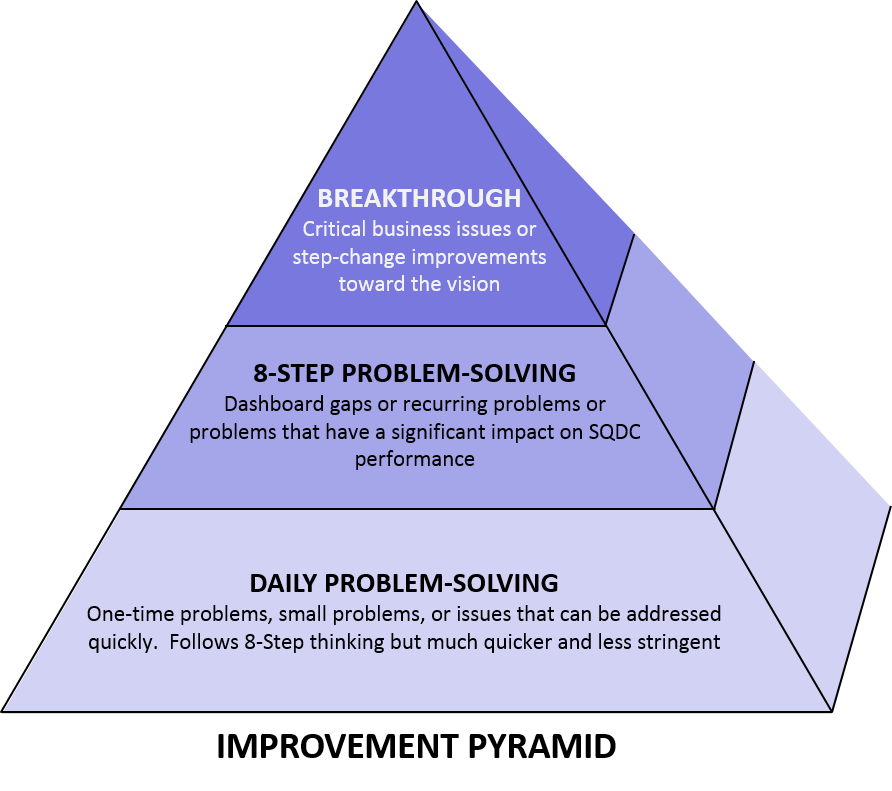
As shown in the diagram, there are 3 basic levels of improvement within an organization. The two lower levels deal with solving problems, i.e., a situation where actual performance does not meet a standard. This assumes that the process or activity is capable of meeting the standard and has done so in the past, thereby focusing the effort on analyzing what changed or what recently occurred that had not been seen before.


Improvement Pyramid-Purple

The third level, breakthrough, involves raising the standard to a new level to meet current or future business needs. Doing this successfully often requires the ability and willingness to question previously held assumptions, and applying creativity to drive step-changes in performance.


In practice, this means that each requires a different type of thinking. By looking for clues regarding what went wrong, problem-solving requires analytical thinking, whereas a breakthrough, by attempting to challenge the status quo and develop new ideas and approaches, requires creative or flexible thinking. Both are needed for an organization to be successful, and both often require effective and consistent coaching to prevent people from being confused.

Because of natural forces and overall effect on the organization, there tends to be significantly more activity at the bottom of the pyramid than at the top, while, although fewer in number, efforts at the top of pyramid tend to result in more effort and a larger gain.


Daily Problem-Solving


Daily Issues
The most common and basic type of problem people face are the daily issues that are often small, one-time annoyances that, although still requiring action, have less effect on the system than the more complex and repeatable issues that the organization faces. These daily issues still require countermeasures because they interfere with the ability of people to do their jobs easily. Additionally, if we ignore them, we are showing disrespect to the people affected and sending the message that waste is acceptable. Addressing them also helps people begin to develop structured problem-solving skills in a fairly simple and easy way.

Those addressing daily issues are still expected to develop a clear statement of the problem, root cause analysis based on 5-whys, and a countermeasure that proves effective in addressing the root cause, but not to the level of a more complex problem being addressed with an A3.


The daily issues are often addressed by those closest to the process who face the problems firsthand and, because of the nature of their jobs, do not necessarily have the time to step back and look for trends and connections between the problems that occur. As with all levels of the organization, the team lead or supervisor is expected to coach and develop the ability of team members to identify and address the problems they face.


Efforts to address daily issues should be documented on a card or simple electronic system to use for coaching, collection of data, and as a means to assure that problem-solving is occurring. Care should be taken, however, to ensure that documenting the effort does not become a burden or the benefits in terms of developing analytical thinking across the organization will suffer.


8-Step Problem-Solving

Whenever a one-time issue recurs or appears on a dashboard as a gap or trend, more structured problem-solving efforts are required. For these issues, an A3 is necessary to assure that the problem is effectively defined, broken down, and addressed. Although it can still be done quickly, the effort is often coached more closely and focused on developing skills more deeply. Rather than a simple 5-whys exercise to determine a root cause, for example, an A3 problem-solving effort would require additional answers for each "why" and verification with data and visiting gemba to see firsthand before moving forward. Since an A3 effort often involves addressing a problem that is fairly complex and/or large, there is also an expectation that the problem is broken down into more specific and actionable issues to be addressed one-at-a-time.


Breakthrough: Raising the Standard

Within any business, there are times when the existing standard is not acceptable. Where problem-solving requires analytical thinking to understand what has changed and how to get a process back to where it once was, breakthroughs often need creative ideas to make the type of changes that will raise performance to a level not experienced before. Doing this successfully requires challenging assumptions to separate fact from deeply held opinions.


In spite of what many people think, everyone has the ability to think creatively and develop innovative approaches to business. The key is to coach and develop people to access and hone creative powers – something that is admittedly not always easy to do. The more experience one gains in a particular field or organization, the more the person tends to stick to what he or she already knows – or at least thinks he or she knows – becoming more and more set in one way of thinking. Success with breakthroughs requires breaking down this defense to get people to begin questioning what they accept as fact to see when it is actually nothing more than a strong opinion.

Analytical thinking, although critical for problem-solving, will rarely lead to innovative breakthroughs required to keep the company moving forward. In his book, Elastic: Flexible Thinking in a Constantly Changing World, Leonard Mlodinow writes that innovation requires "bottom up" thinking driven from inside the person versus the "top down" outside-driven thinking generally required for problem-solving.

An important point about the balance of analytical and breakthrough thinking is that a company cannot use innovation to stay ahead of quality and productivity problems. There must be a solid foundation of problem-solving and stable processes upon which to build and hold the breakthroughs.

Both are Required

What makes lean powerful, the combination of analytical problem-solving and innovative thinking, is also what makes the transformation so difficult. Understanding the different dimensions of improvement is fundamental to assuring a successful journey and avoiding the confusion and frustration that many companies experience.

Monday, January 29, 2018

We Don't Make Cars: Applying Lean to Other Industries


People don't go to Toyota to work, they go there to think"Taiichi Ohno

Although much of what we now call lean has been practiced by Toyota and its suppliers for decades, most of the world began to learn about it in the 1990s with books like The Machine that Changed the World and Lean Thinking. It has been more than 25 years since then and, although companies in a variety of industries are well into their lean journeys and showing positive results, there are still many people who have trouble thinking beyond lean as a strategy for high-volume or automotive manufacturing.

As someone who has worked in a variety of industries, I have encountered difficulties applying lean thinking in certain situations, but it was due more to cultural reasons than industry differences. Regardless of the industry, if the organization has an aim and uses processes to achieve that aim – and they all do – lean thinking applies. Lean is about continually thinking, learning, and getting better about what you do; not about producing cars. If your processes are not perfect, you don't already know everything there is to know about your business, or change regularly occurs in your organization or industry, then lean can help.

During my early days in oil and gas, I got a lot of pushback about the suitability of lean to the industry. When I heard the "we don't make cars" argument, my response was usually if Toyota produced oil & gas and we made cars, we would say lean applies only to oil and gas. The same goes for any industry.

It's Always Easier Somewhere Else

It is common to talk to people in various industries who believe that lean applies easily to other industries but is much more difficult in their own. Even within an industry, I've met people who believe their own circumstances are so unique that, even though other organizations or areas may apply lean thinking fairly successfully, it does not fit their own situation.

Getting people past the notion that lean will not work in an organization or industry requires continual coaching, demonstration, and a lot of patience. It also requires educating people about the basis for lean and how it drives learning and improvement. The key is to get people to understand lean beyond the tools so they will start to see where they have gaps in performance, knowledge, and learning. A tools-focus in lean, something that is far too common, leads people to google things like 5S, value stream mapping, or SMED, and only find examples of application to Toyota or other high-volume manufacturing situations. Seeing examples like this tends to cement the idea that the practice is unsuited to their own situation.

The Lean System

Lean is about thinking and learning, and if a business is experiencing problems of any kind, there is room to learn. The basic steps to drive lean are shown below. The key to success is to use the steps to learn by doing, which requires clarity on the expected result of each decision, action, and process, and using the actual results to see where things did or did not provide results as expected.

Lean is a system comprised of several elements that work together to drive learning and improvement and, like any system, if you leave out one or more components, it won't work.

1. PURPOSE: Every organization must understand its purpose to have any chance of sustaining success. The purpose, consisting of why the company exists (the mission) and where it is headed (the vision) must drive everything it does. The key is to make it clear, a stretch (difficult, but not impossible), inspiring, and focused on providing value.

2. BUSINESS NEEDS: Visions tend to describe the future in general terms like industry-leading, most respected, improve society, etc. This is okay because what is considered industry-leading today is not necessarily what it will mean 5-10 years from now and you don't want a specific target to mislead the organization. This element of lean thinking includes the 3-5 year objectives that make the vision much more concrete. Although many industrial companies often identify the gaps in terms of safety, quality, delivery, cost, and people development (SQDCP), it is important to tailor the objectives to the organization's needs. Basically, the objectives define how the organization needs to perform in the next 3-5 years in order to remain on-track to the vision.

Also included in this element is the one-year plan that gets even more specific regarding what needs to happen in the current year to remain on-track to the 3-5 year objectives. The one-year plan identifies the current year SQDCP targets, which defines how the organization needs to perform this year given its current processes and systems (assuming that regular problem-solving will be required to deal with the daily problems), as well as the 2-3 areas where a step-change in performance is required to stay on track to the 3-5 year objectives (i.e., kaizen/breakthrough problem-solving). Using an oil and gas producer, a current year target could be production of 25,000 barrels of oil produced per day (possible with current processes and systems), while a breakthrough could be the need to reduce cost per barrel from $24 to $18 within 3 years (which would require a step-change in processes or systems).

3. STANDARDS: Once the gaps and performance targets are clear, it is necessary to identify the standards that need to be met in line with business needs. An example of standards within an oil and gas operation could be that meeting a production target requires an offshore platform to operate at 95% reliability, which, in turn, requires a maintenance technician to change a pump filter in 24 minutes. In another example, a coffee shop could determine that, to meet customer requirements, all customers must receive their coffee within 4 minutes of walking into the shop, requiring the person taking the order to select any product on the order screen within 2 seconds. Setting standards requires a clear understanding of the business and continual improvement.

4. STANDARD WORK: Standard work consists of the instructions that, if followed, will enable the standards to be met. In the examples above, instructions provide a step-by-step description of the work to be done to change the filter in 24 minutes or serve the customer within 4 minutes. Two key points about standard work are (1) the instructions should be created and regularly improved by the people who actually do the work; and (2) the instructions must be clear and simple to follow. It is also important that the standard work is regarded as the best known way to perform the work today, and must be followed until a better way is discovered and the instructions are changed.

5. ACTUAL PERFORMANCE: Learning requires clearly and continually measuring the actual performance to understand where the gaps between performance and the standards exist. If actual performance meets the standards – the pump filter is changed in 24 minutes – then the thinking returns to step 2 to continually assure that business has not changed and that the standards still meet the business or customer needs.

6. IDENTIFY PROBLEMS/GAPS: The real power of lean thinking occurs when actual performance does not meet standards because this is where continual improvement truly happens. For the business to improve, we need people to quickly speak up when problems occur. Whether through an andon signal (lights and music that immediately grab attention) or dashboards that are updated frequently, the key is to find ways to make all problems highlighted quickly. To assure this happens, leaders need to encourage and recognize team members for identifying problems quickly. Taking it one step further, making problems visible should be an expectation of every person in the organization.

7. RESOLVE PROBLEMS: Once problems are identified – i.e., actual performance does not meet the standard – there needs to be a consistent way to understand and resolve the gaps. Rather than calling on black belts to come in and lead the process, lean requires that everyone become problem-solvers. Those closest to the work need to be actively involved in closing the gaps and, to make this happen, leaders need to teach and coach team members how to do it. In many cases, problem-solving leads to changing standards and/or standard work to ensure that improvements stick.

8. DO IT AGAIN: The lean system requires that the process never ends, so the team needs to continue to review business needs, set and revise standards, identify gaps in performance, and solve problems.

Not as Easy as it Sounds

Although following the lean system as described above appears fairly simple and straightforward, it is anything but easy. Each step requires transformation in leadership, thinking, and culture to be effective. Two areas that generally require significant change include transforming managers into coaches and making a culture where it is safe – and even expected – to make problems visible.

The all-too-common approach of focusing on the tools will make the application of lean to other industries difficult – if not impossible. Focusing on the philosophy and transformation in the way people think and approach the business, however, will make the application to other industries far easier and significantly more successful.

Wednesday, January 3, 2018

The Lean Journey Starts with Appreciating the Business as a System

“There is not a day I don’t think about what Dr. Deming meant to us. Deming is the core of our management.”    - Shoichiro Toyoda

According to W. Edwards Deming, the first thing he did when meeting with Japanese business leaders in 1950 was draw a diagram of a business as a system on the board (shown below from Out of the Crisis).  It was a simple diagram – almost too simple for many to understand its profound significance.  So, what is it about this diagram that literally changed the world and helped some organizations develop competitive advantages that they were able to sustain for many years?


At its most basic level, the objective of the diagram is to show that every business is a system and needs to be managed as such.  When most people hear this, they nod their heads in agreement as if it is nothing new.  After looking at the way many organizations are run, however, it becomes obvious that the concept is still not well understood. 

When viewing a business as a system, it becomes clearer which common business practices actually interfere with long-term success.  In fact, the more one learns about systems thinking, the more obvious it becomes that the chance of achieving any level of long-term success without it is very small.

Every System Must Have a Clear Purpose

Every business exists to achieve an aim and uses a series of handoffs, processes, and subsystems to achieve that aim.  Sounds simple enough but in many – possibly even most – companies, this is forgotten or never truly appreciated.  In far too many organizations, the aim is not clear, not constant, or too heavily focused on monetary gains.  Without a clearly stated and unchanging purpose that is focused on value and meaningful to everyone, people will define it on their own, leading to conflicts, waste, and significant losses.  Deming went as far as to say that without a purpose, there is no system.

I consider the aim to be comprised of the mission (why the organization exists) and vision (where it is headed).  In practice, this means that the organization must stay true to its mission while assuring all targets, objectives, and activities support achieving the vision.  In the most advanced lean thinking organizations, this is much more obvious than in other companies.

The Interactions Must be Clear and Continually Improve

In addition to assuring the aim is clear to everyone in the organization, the interactions between each person and team needs to be clear and continually improved.  Organizations operate in a highly complex manner and gaining an understanding of the interactions and how they create value for the customer is a difficult but necessary task. 

A critical point about systems is that every person in the organization must understand how the work they do contributes to the aim.  This means, for example, that a Maintenance Technician understands his or her role is to assure machines are capable of producing parts of the right quality when needed.  To do that requires high reliability, fast turnaround for maintenance and repairs, and helping the machinists understand how to perform routine maintenance activities quickly and effectively.  Managers have the responsibility to help team members understand their work to this level of detail, including developing an understanding of whom they support in the overall system.

Standards must be established to clarify the work and the interactions and clearly communicate to people what is needed to assure materials and information move through the system to produce value consistently.  Whenever the standards are not met, problem-solving must be done to understand why and to make corrections.

Leaders Must Understand the Level of Complexity

Appreciating systems goes beyond understanding the interactions that take place throughout the organization.  It includes the understanding that the results of actions are not always simple and easy to determine.  For example, forcing the supply chain team to reduce the cost of incoming materials can result in increasing overall costs for the company, even though logic would dictate otherwise.

Organizations are complex, and the larger the organization, the more complex it becomes to understand the effect of a decision or action.  Large-scale changes can, and often do, have damaging effects that are difficult to predict beforehand, and are not easy to understand afterwards.  All changes must be accompanied by an expectation of the effect on the organization, and results must be continually checked against the expectations to drive learning and help improve understanding of the system.

Fragmented Thinking vs Systems Thinking

The more one develops an understanding of systems thinking, the clearer it becomes that many commonly accepted business practices hamper, rather than help, improved performance.  An example is the heavy focus placed on individual performance by most organizations. Systems thinking naturally puts the accountability for performance on the system to a much greater extent than on the individual.  Deming used to say that 94% of the problems a company faces come from the system (and are therefore management’s responsibility) and 6% are related to the people in the system.  The time and emphasis generally put into a typical performance review system, however, shows that many of us believe the exact opposite.  We rate, rank, and hold people across the organization responsible for performance in a system that is most likely flawed.  In other words, rather than focus our efforts on improving the system when performance is below expectations, we assume that putting pressure on the individual will improve results, even though the person may have little or no authority to do anything other than try harder, go around the system, or focus on making it look like improvement is occurring whether it actually is.

When traditional performance reviews are combined with the process of setting objectives, the result is often optimization of one team or individual rather than the system or the organization’s overall aim.  For example, a finance team that focuses on improving the closing process by requiring extra work from the operations team could result in taking time away from producing products or fixing problems and, although the books are closed faster each month, overall performance may suffer.

The typical organization chart is another example that shows the popularity of fragmented thinking.  The most commonly used layout for an organization chart shows little more than who has power.  Using a chart that is organized by the system (e.g., names and titles on a system diagram), however, would show where people fit in the value stream, as well as the relationships between internal customers and suppliers.  It would be much more valuable to helping people understanding their jobs than a chart that shows who the boss of whom.

These are simple examples that demonstrate the destructive effects of leaders who do not understand how systems work.  When the system is not understood and actively managed, priorities are unclear, causing continual conflict between people and teams, and effectively destroying the system.

Managers are Responsible to Create and Improve the System

When leaders come to the realization that creating, managing, and improving the system is their responsibility, the organization will begin to transform.  The focus moves to the most important parts of the organization and people start truly working together, rather than against each other, to improve performance.

Although appreciation for a system is only one of the four elements of what Deming referred to as his System of Profound Knowledge, it is something that helps provide context for the others – theory of knowledge, knowledge of variation, and psychology – and the understanding that they must all be present and work together to drive transformation.

Tuesday, December 19, 2017

Why Lean Fails

Why do so many organizations give up on lean even after experiencing initial success with the effort? There are several examples of companies in various industries that experienced sustained success with lean, but these examples seem to be few and far between when compared to the large number of companies that attempt it and fail.

To be clear, lean doesn't fail . . . it's the transformation that fails. While there are many reasons for the failure, there are a few that seem to be common across various organizations. Regardless of which one or more of these reasons apply, correcting them is possible only when leaders begin to develop a deep understanding of lean and realize that the responsibility for the transformation rests squarely on their shoulders rather than something that can be delegated to lower levels in the organization.

Although the premise of lean is simple, integrating it into an organization is highly complex, and the larger the organization the more complex it becomes. Lean thinking is a system that requires understanding how the elements come together to drive continual improvement in support of the organization’s aim. The big gains that some organizations have been able to achieve with lean are only possible after fundamentally transforming the way people think, lead, and approach problems.

The list below is far from comprehensive but is meant to stimulate thinking and reflection to understand the reasons for failure and to help move toward fundamentally changing the culture to enable it to increase and sustain the rate of improvement.
  1. Fail to understand the level of transformation required: Far too often, organizations attempt to lay lean on top of a traditional leadership system and expect things the change. It is a simple fact that nothing will change unless the leadership system changes, and failing to understand this will lead to frustration and disappointment in the effort. This is often the main reason behind what appears to be a lack of commitment by the organization’s leaders. People cannot commit to something they do not understand.
  2. Focus on the home runs: Far too many people read about the Toyota and its rise from virtual ashes in the 1940s to become the most successful automaker in terms of sales, profit, and market capitalization. When reading an article about it or hearing someone tell the Toyota story, however, misses the point that it was the decades of small, continual improvements that led to significant step changes in performance. Although there are many examples of large innovative improvements at Toyota and other lean thinking companies, they happen because of the collective change in thinking that occurs through a focus on small continual improvements and daily problem-solving.
  3. Focusing on financial benefits only: After experiencing a few early improvements, it is very common for leaders to become focused on the financial benefits of the effort and change their focus from learning to cost savings. When this happens, lean becomes a set of tools rather than a system of continual improvement. SQDC (safety-quality-delivery-cost) is replaced by C, and understanding the true meaning of improvement is lost. As small improvements and learning is virtually ignored and the big improvements (the home runs mentioned above) are celebrated, people will do what it takes to show big gains, whether real or fabricated, and any early success with lean will break down and die.
  4. Focus on the tools rather than the thinking: Without a deep understanding of lean as a system and the fundamental reasons for its success, it is not possible to think beyond the tools. The tools are easy to understand while the theory behind lean is not. Leaders, especially in the west, are much more interested in things that are concrete, practical, provide quick results, and are easy to explain than organizational theory, psychology, learning, and systems thinking.
  5. Lack of systems thinking: Unless leaders understand the complexity of the organization’s system, including how the subsystems work together to drive performance, people and teams will continually compete with one other resulting in continual performance problems and increasing sub-optimization. One of the most critical responsibilities of leaders is to create and continually improve the organization’s system to enable it to achieve its purpose. This includes helping everyone understand clearly how the work they do supports the achievement of organizational objectives.
  6. Lack of patience: If you are looking for quick results, lean is probably not the way to do it. As mentioned above, lean requires a shift in the way people think, lead, and perform work, and it takes time – a lot of time – to make it happen. Although results will be seen along the way, there will be gaps that make it seem like nothing is happening. W. Edwards Deming once said that transformation is discontinuous, so it is important to understand that there will be many instances of two steps forward and one step back. The key is to stick with it and remain constant in the purpose and the transformation.
When any of the above characteristics are present, people who are against lean will gain ammunition to bury the effort. It is very easy for the people who feel threatened by lean to plant seeds of doubt in those who are on-board with the change. Getting past this initial stage of the transformation requires regular reflection and continual learning by leaders to see the signs and address them as they happen.

Wednesday, October 18, 2017

Why Questioning is Critical to Lean Leadership

One of the most critical but underappreciated skills required to successfully transform an organization toward lean thinking is the ability of leaders to use questioning to coach and develop team members. As important as coaching is to leadership, however, it is also one of the most challenging for people to understand and apply in their daily interactions with others. Like much of lean thinking, using questions to develop people is simple and logical but difficult to put into practice.

Learning to use questioning usually requires understanding why it works and how it helps the leader and the person being coached. It is not an attempt to portray the leader as a wise or deep-thinking philosopher who has all the answers. It is a way to help understand what a person is thinking and how to tailor the conversation toward helping them see a situation in a different way. When a leader begins to understand why questioning is important, he or she starts to see how to apply it to a variety of interactions throughout the day.

Why We Question 

There are some basic reasons why questioning is an effective way to teach and learn. Understanding and applying questioning effectively requires considering these reasons during conversations with team members and reflecting afterwards to continually improve your ability to coach and develop others.

The most basic reasons to question rather than tell in conversations with people includes the following:
  1. To know what the person is thinking.  You can't help correct incorrect assumptions if you don't know what those assumptions are and why the person is making them. Use questions to better understand the assumptions behind actions and where they are coming from. 
  2. To help the person see things the way you do.  When you see a situation differently than the person you are coaching, you want to help the person to see the situation from your perspective. He or she is likely missing something, so you need to question to find out what it is and to help them understand. 
  3. To help you understand the facts.  It is possible that the person you are coaching knows more about what's going on at gemba than you do. If you believe in lean thinking, you must respect this and be open to the idea that you could be wrong and can learn something from the person you are coaching. Questioning is the only way to help you understand what you may be missing. 
  4. To help the person understand the value of thinking slowly and deeply.  I have found that one of the most beneficial ways to help someone develop is to get them to slow down and deeply think through a situation before acting. Most people feel overloaded, and when faced with a problem, just want to get it off their desks as quickly as possible and move on. Especially for the big problems, though, jumping to countermeasures without thinking deeply about the situation rarely eliminates the cause of the problem and, even when it does, does not tend to make life easier. It often ends up creating extra work or just buries the problem until the next time it comes around. Using creativity and innovation to address root causes and truly make things easier generally requires reflection and deep thinking to understand which pieces of information are fact and which are assumptions. 
  5. To get the person actively involved in the learning process.  Studies show that passive listening – sitting and listening to someone lecture – is a far less effective way to learn than active participation. Active participation involves engaging the mind when attempting to learn, and answering questions about a situation provides a good way to engage a person's mind. On the other hand, listening to someone lecture does not require engagement and allows the listener's mind to wander to other things going on at the time. 
Although it depends on the circumstances and the person being coached, some questions that can help provide clarity about the process and help develop the ability to coach include:  What do/did you expect to happen? What do you think is causing the problem? Did you learn anything that you didn't know when you started investigating the problem? I have also found that asking why is the most effective way to get someone to clarify their thinking and start to see what they may be missing.

Mixed Messages 

One of the reasons that people have difficulty with coaching is that those of us who teach and write about lean are likely sending mixed messages regarding the why and how of the process. On the one hand, we tell leaders that they don't need to be experts in everything and that it is okay to admit that they don't have all the answers. On the other hand, we talk about people like Taiichi Ohno and Hajime Oba and the ability these people had to see problems quickly and clearly, and coach others to the answers.  I believe that this turns people off of the process because most will never measure up to these legendary leaders. In actuality, these two and other legendary lean figures didn't know the answers but they did know how to use questioning to gather facts (or identify when the facts are not yet gathered) and help the person being coached to arrive at an answer.

Start Small

When I work with leaders to develop coaching skills, I recommend starting small with a few key conversations each day or week.  Teaching the ability to question – which, by the way, also requires questioning – is easier when connected to the overall philosophy of lean thinking. Decisions should never be made without understanding the facts, and understanding the facts often requires going to gemba and asking questions to those who are closer than you are to the processes involved. When people understand and believe this, questioning starts to become a normal part of leading teams. 

Sunday, April 30, 2017

Short-Term vs Long-Term: They Both Matter

Over the years, I have found many organizations the lack the ability to effectively balance short-term pressures with long-term improvement.  The situation causes frustration in people because, in the end, the short-term virtually always wins while the focus on the long-term suffers. 

There are a number of reasons for tendency toward short-term thinking.  First of all, people tend to be measured and rewarded based on achieving current year targets much more than long-term improvements.  Another factor driving a short-term focus is the targets are right in front of people.  The gaps are easy to see and it's clear that, if the problems are not addressed immediately, meeting the targets may not be possible.  Long-term gaps are also more difficult to measure and it's easy to justify dealing with them later. 

Which is More Important? 

So how should people deal with this type of situation?  We can't ignore the short-term targets because they are often necessary to assure we will be around for the long-term.  On the other hand, the more we ignore the long-term, the more we jeopardize our survival.  Regarding the question of which is more important, the answer is actually they're both important.  Customers, as well as investors and fellow team members, rely on our ability to deliver what we promise. 

Assuming that annual targets were set based on current capabilities, we should be able to meet them with enough focus and daily problem-solving.  After all, we made a commitment, so we should feel compelled to meet it.  On the other hand, if the targets do not have some semblance of reality, the company has much bigger problems, and meeting them most likely won't happen with or without a heavy focus and effort. 

When a problem arises today that will affect meeting short-term targets, it is difficult for most people to ignore it.  People will naturally jump in to address the problem and get performance back on track, especially if nobody else is available or a particular type of expertise is needed. 

The real problem for the organization occurs when people get so consumed with short-term problems that the long-term becomes an afterthought.  In reality, it seems that the poorer we are at taking care of the long-term, the more short-term problems we battle year-after-year. 

Implementing the 80/20 Rule 

I have found that the best way to assure we take care of both short- and long-term objectives is to consciously split time between the two, and in the most general terms, the split to be 80/20 (80% on the short-term and 20% on the long-term).  This is a general rule because the closer one is to where direct value is created (e.g., the factory floor in manufacturing, the sales counter in retail, or the wellhead in oil and gas production), the more time is focused on short-term objectives.  For example, a team member working on an assembly line has to focus most of his or her day on performing work within takt time that meets standards.  Although problems will regularly arise that the person will need to address, they are generally related to short-term safety, production, quality, and cost targets.  For this person, the split may be 95/5. 

Long-term projects, whether new or carried over from previous periods, should be apparent at the start of year when annual plans are being developed.  Making sure that these projects make their way into the 20% is important at this point, as is assuring that they require no more than 20% of the person’s effort.  Catchball and careful planning is critical to align expectations in the split between short-term and long-term focus, as well as the specific projects that fall into the 20%. 

As with any project, whether related to the short-term or long-term, clear objectives are needed along with a detailed and measurable plan.  The better and more measurable the plan, the easier it is to ensure progress.  Implementing a rhythm for regular reviews is necessary to assure the project is progressing according to the plan, and to determine whether changes in the plan, priorities, or resources assigned are needed to get it back on track.  We all know how to measure the short-term targets – it's the longer-term projects that require serious thought to determine the right measures.  Measuring progress to a project schedule will help but measuring quality of deliverables along the way is even better. 

Applying the 80/20 rule and ensuring that short-term and long-term objectives are met requires that managers be close to team members and truly understand what is going on in the workplace.  Rather than hearing about delays when it is too late to help make adjustments, managers must have enough awareness to provide help to get the project back on track before targets need to be changed. 

Intention is Everything 

It should be noted that none of this applies to an organization where meeting short-term targets is everything and commitment to the long-term consists of nothing more than words.  If the environment is so toxic that shipping defective products or cutting corners just to meet short-term targets is the norm, it has much deeper problems and attempting to manage through an 80/20 split will do little to help.  Like most things in business, long-term success begins with an obsession around understanding and meeting the needs of customers. 

Just like short-term objectives, long-term projects need to have targets based on successfully progressing plans, and these targets must be reviewed regularly – at least monthly – to ensure they are on-track and understand if help is needed.  If the split generally follows the 80/20 rule, and long-term commitments are taken as seriously as short-term targets, the chances of success will increase.  Discipline is needed to fight the tendency to put off developing or maintaining the measures and to skip the reviews now and then.  Like much of lean thinking, the concept is simple, while making it work effectively requires a lot of focus, effort, and consistency in behavior.