Showing posts with label continual improvement. Show all posts

Tuesday, June 5, 2018

Problem-Solving & Kaizen: Are They Different?

One of the most important – and elusive – objectives of lean is creating a culture of continual improvement throughout an organization. In most cases, this requires changing the way people think and approach their work, and although helping people transform is never easy, it becomes even more difficult when those driving lean are not clear about the different types of improvements and how to approach each. Solving a relatively small, one-time problem, for example, requires different thinking than reducing fixed costs across the operation by 20%. It is far too common, though, to attempt both by using the same process - i.e., handing someone an A3, telling them to "do a kaizen," and asking them to complete it. Besides the wasted time this can cause, it can confuse and frustrate the person being coached.

The objective of this post is to provide some clarity about the different types of improvement. Although the subject often leads to considerable debate and disagreement, I believe it is an important one, and something that lean professionals need to understand to help move an organization toward a sustainable culture of improvement.


The Different Levels

As shown in the diagram, there are 3 basic levels of improvement within an organization. The two lower levels deal with solving problems, i.e., a situation where actual performance does not meet a standard. This assumes that the process or activity is capable of meeting the standard and has done so in the past, thereby focusing the effort on analyzing what changed or what recently occurred that had not been seen before.
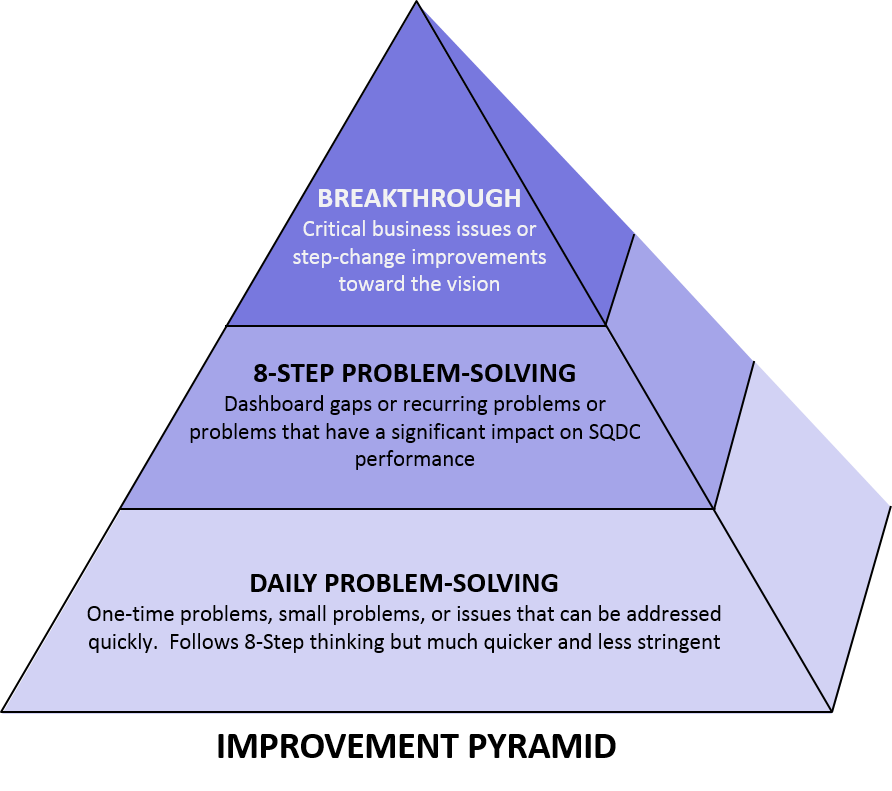

Improvement Pyramid-Purple

The third level, breakthrough, involves raising the standard to a new level to meet current or future business needs. Doing this successfully often requires the ability and willingness to question previously held assumptions, and applying creativity to drive step-changes in performance.


In practice, this means that each requires a different type of thinking. By looking for clues regarding what went wrong, problem-solving requires analytical thinking, whereas a breakthrough, by attempting to challenge the status quo and develop new ideas and approaches, requires creative or flexible thinking. Both are needed for an organization to be successful, and both often require effective and consistent coaching to prevent people from being confused.

Because of natural forces and overall effect on the organization, there tends to be significantly more activity at the bottom of the pyramid than at the top, while, although fewer in number, efforts at the top of pyramid tend to result in more effort and a larger gain.


Daily Problem-Solving


Daily Issues
The most common and basic type of problem people face are the daily issues that are often small, one-time annoyances that, although still requiring action, have less effect on the system than the more complex and repeatable issues that the organization faces. These daily issues still require countermeasures because they interfere with the ability of people to do their jobs easily. Additionally, if we ignore them, we are showing disrespect to the people affected and sending the message that waste is acceptable. Addressing them also helps people begin to develop structured problem-solving skills in a fairly simple and easy way.

Those addressing daily issues are still expected to develop a clear statement of the problem, root cause analysis based on 5-whys, and a countermeasure that proves effective in addressing the root cause, but not to the level of a more complex problem being addressed with an A3.


The daily issues are often addressed by those closest to the process who face the problems firsthand and, because of the nature of their jobs, do not necessarily have the time to step back and look for trends and connections between the problems that occur. As with all levels of the organization, the team lead or supervisor is expected to coach and develop the ability of team members to identify and address the problems they face.


Efforts to address daily issues should be documented on a card or simple electronic system to use for coaching, collection of data, and as a means to assure that problem-solving is occurring. Care should be taken, however, to ensure that documenting the effort does not become a burden or the benefits in terms of developing analytical thinking across the organization will suffer.


8-Step Problem-Solving

Whenever a one-time issue recurs or appears on a dashboard as a gap or trend, more structured problem-solving efforts are required. For these issues, an A3 is necessary to assure that the problem is effectively defined, broken down, and addressed. Although it can still be done quickly, the effort is often coached more closely and focused on developing skills more deeply. Rather than a simple 5-whys exercise to determine a root cause, for example, an A3 problem-solving effort would require additional answers for each "why" and verification with data and visiting gemba to see firsthand before moving forward. Since an A3 effort often involves addressing a problem that is fairly complex and/or large, there is also an expectation that the problem is broken down into more specific and actionable issues to be addressed one-at-a-time.


Breakthrough: Raising the Standard

Within any business, there are times when the existing standard is not acceptable. Where problem-solving requires analytical thinking to understand what has changed and how to get a process back to where it once was, breakthroughs often need creative ideas to make the type of changes that will raise performance to a level not experienced before. Doing this successfully requires challenging assumptions to separate fact from deeply held opinions.


In spite of what many people think, everyone has the ability to think creatively and develop innovative approaches to business. The key is to coach and develop people to access and hone creative powers – something that is admittedly not always easy to do. The more experience one gains in a particular field or organization, the more the person tends to stick to what he or she already knows – or at least thinks he or she knows – becoming more and more set in one way of thinking. Success with breakthroughs requires breaking down this defense to get people to begin questioning what they accept as fact to see when it is actually nothing more than a strong opinion.

Analytical thinking, although critical for problem-solving, will rarely lead to innovative breakthroughs required to keep the company moving forward. In his book, Elastic: Flexible Thinking in a Constantly Changing World, Leonard Mlodinow writes that innovation requires "bottom up" thinking driven from inside the person versus the "top down" outside-driven thinking generally required for problem-solving.

An important point about the balance of analytical and breakthrough thinking is that a company cannot use innovation to stay ahead of quality and productivity problems. There must be a solid foundation of problem-solving and stable processes upon which to build and hold the breakthroughs.

Both are Required

What makes lean powerful, the combination of analytical problem-solving and innovative thinking, is also what makes the transformation so difficult. Understanding the different dimensions of improvement is fundamental to assuring a successful journey and avoiding the confusion and frustration that many companies experience.

Tuesday, March 13, 2018

Lean by Playing One Point At-a-Time


"One thing that makes Chris [Evert] such a great champion, is that she doesn't play games or sets, she plays points." – Billie Jean King

I've played tennis most of my life and learned many years ago about the importance of the mental aspect of the game. One thing that particularly impressed me early on was the ability of Chris Evert to maintain an intense level of focus regardless of the score. Whether she was winning handily or losing badly, her expression and focus did not seem to waver. This ability helped her come from behind on many occasions and beat her opponent, even when it appeared that she had no chance of winning. Her focus was never the match, set or game, but the point. Her strategy was based on the idea that points mattered, not the score, and by focusing on winning each point, the matches would take care of themselves.

I didn't know it at the time but this greatly helped me to understand lean thinking. Keeping the focus on what's happening right now, whether a machined part, assembly, customer interaction, or drill bit location, helps drive improvement by immediately seeing when something goes wrong. When we become distracted by the overall score – the monthly or annual budget – we miss the little things that happen every day and every hour that add up to poor long-term performance.

At its most basic level, lean involves setting standards and addressing the problems that interfere with meeting the standards. This means that, to make lean work, we must: (1) have standards; and (2) provide an easy way to know when the standards are not met. It is a simple concept but is very difficult to put into practice. Company culture, leadership systems, and human behavior often force people to worry about the big picture and forget that the results consist of many small processes and interactions. As a consequence, people ignore the small problems and fail to see that spending 5 minutes looking for a tool, for example, has an impact on missing a monthly or annual production target.

It Starts with Leaders

For a variety of reasons, leaders tend to focus on the big picture and ignore the small problems. What is often forgotten, however, is that the big picture includes creating an environment where everybody identifies and addresses problems every day. By showing concern only about the big gaps in performance, leaders are telling people that the small things don't matter. As an example, although missing a bolt to complete a job can be a headache for a person in the factory, a leader may decide that it is not significant enough to spend time helping the person understand the cause and develop a countermeasure for the next job. The message that some problems are important to fix while others are not sends mixed messages about the importance of problem-solving. In effect, the leader is losing points while thinking about the match.

Changing the culture requires helping people understand that every instance where a standard is not met is a problem and needs to be resolved. Doing this requires spending time at gemba to see when it happens, helping people recognize the small problems that happen (or validating that the problems are important enough to address), and coaching people to effectively solve problems. The objective is to get people solving the problems they face every day.

Changing the Daily or Weekly Standup

Another way to help change the way people think about problems is through the daily or weekly standup meetings. A traditional standup meeting reviews how the team performed since the last meeting, e.g., what problems interfered with achieving the plan discussed in the previous day's meeting. When the discussion is distracted by the annual or monthly budget rather than what happened yesterday, important information is missed. Achieving the budget is obviously important but since meeting standards is the way to achieve the budget, the focus needs to be on what got in the way of meeting standards. When the focus is the budget, the team misses a critical objective of lean: solving problems and performing better every day. In tennis, the standards include things like the stroke, footwork, and ball placement. It is these things that enable a player to win points through an intense focus on doing them correctly and making adjustments when problems happen rather than looking at the score. In work, the standards and associated instructions are the stroke, footwork, and ball placement.

When a company's culture suffers from an attention deficit disorder (a common condition in many organizations) its inability to see the small problems interferes with the daily problem-solving required to continually improve and create a system capable of meeting the budget. By allowing this to continue – i.e., worrying more about the score than the point or the shot – the gap to the budget will continue to grow because the problems are not being addressed. It is also far easier to address the small problems every day than to attempt to take on the entire gap between actual performance and the annual budget.

Focus on the Points

University of Alabama football coach Nick Saban once said, "the process is really what you have to do day in and day out to be successful." In lean terms, he's referring to understanding and continually focusing on the standards. When the focus is results rather than the work that produces the results, standards become meaningless, problems become too big to address, and the gap continues to grow. Besides the fact that it is far easier to identify and correct gaps to meeting a standard than missing a monthly production target, the more people address problems – regardless of how small – the better they get at problem-solving. I've learned the hard way many years ago that my chances of coming back from a 5-1 deficit are much better when I focus on the next point than worrying about winning the next six games.

Sunday, April 30, 2017

Short-Term vs Long-Term: They Both Matter

Over the years, I have found many organizations the lack the ability to effectively balance short-term pressures with long-term improvement.  The situation causes frustration in people because, in the end, the short-term virtually always wins while the focus on the long-term suffers. 

There are a number of reasons for a tendency toward short-term thinking.  First of all, people tend to be measured and rewarded based on achieving current year targets much more than long-term improvements.  Another factor driving a short-term focus is the targets are right in front of people.  The gaps are easy to see and it's clear that, if the problems are not addressed immediately, meeting the targets may not be possible.  Long-term gaps are also more difficult to measure and it's easy to justify dealing with them later. 

Which is More Important? 

So how should people deal with this type of situation?  We can't ignore the short-term targets because they are often necessary to assure we will be around for the long-term.  On the other hand, the more we ignore the long-term, the more we jeopardize our survival.  Regarding the question of which is more important, the answer is actually they're both important.  Customers, as well as investors and fellow team members, rely on our ability to deliver what we promise. 

Assuming that annual targets were set based on current capabilities, we should be able to meet them with enough focus and daily problem-solving.  After all, we made a commitment, so we should feel compelled to meet it.  On the other hand, if the targets do not have some semblance of reality, the company has much bigger problems, and meeting them most likely won't happen with or without a heavy focus and effort. 

When a problem arises today that will affect meeting short-term targets, it is difficult for most people to ignore it.  People will naturally jump in to address the problem and get performance back on track, especially if nobody else is available or a particular type of expertise is needed. 

The real problem for the organization occurs when people get so consumed with short-term problems that the long-term becomes an afterthought.  In reality, it seems that the poorer we are at taking care of the long-term, the more short-term problems we battle year-after-year. 

Implementing the 80/20 Rule 

I have found that the best way to assure we take care of both short- and long-term objectives is to consciously split time between the two, and in the most general terms, the split to be 80/20 (80% on the short-term and 20% on the long-term).  This is a general rule because the closer one is to where direct value is created (e.g., the factory floor in manufacturing, the sales counter in retail, or the wellhead in oil and gas production), the more time is focused on short-term objectives.  For example, a team member working on an assembly line has to focus most of his or her day on performing work within takt time that meets standards.  Although problems will regularly arise that the person will need to address, they are generally related to short-term safety, production, quality, and cost targets.  For this person, the split may be 95/5. 

Long-term projects, whether new or carried over from previous periods, should be apparent at the start of year when annual plans are being developed.  Making sure that these projects make their way into the 20% is important at this point, as is assuring that they require no more than 20% of the person’s effort.  Catchball and careful planning is critical to align expectations in the split between short-term and long-term focus, as well as the specific projects that fall into the 20%. 

As with any project, whether related to the short-term or long-term, clear objectives are needed along with a detailed and measurable plan.  The better and more measurable the plan, the easier it is to ensure progress.  Implementing a rhythm for regular reviews is necessary to assure the project is progressing according to the plan, and to determine whether changes in the plan, priorities, or resources assigned are needed to get it back on track.  We all know how to measure the short-term targets – it's the longer-term projects that require serious thought to determine the right measures.  Measuring progress to a project schedule will help but measuring quality of deliverables along the way is even better. 

Applying the 80/20 rule and ensuring that short-term and long-term objectives are met requires that managers be close to team members and truly understand what is going on in the workplace.  Rather than hearing about delays when it is too late to help make adjustments, managers must have enough awareness to provide help to get the project back on track before targets need to be changed. 

Intention is Everything 

It should be noted that none of this applies to an organization where meeting short-term targets is everything and commitment to the long-term consists of nothing more than words.  If the environment is so toxic that shipping defective products or cutting corners just to meet short-term targets is the norm, it has much deeper problems and attempting to manage through an 80/20 split will do little to help.  Like most things in business, long-term success begins with an obsession around understanding and meeting the needs of customers. 

Just like short-term objectives, long-term projects need to have targets based on successfully progressing plans, and these targets must be reviewed regularly – at least monthly – to ensure they are on-track and understand if help is needed.  If the split generally follows the 80/20 rule, and long-term commitments are taken as seriously as short-term targets, the chances of success will increase.  Discipline is needed to fight the tendency to put off developing or maintaining the measures and to skip the reviews now and then.  Like much of lean thinking, the concept is simple, while making it work effectively requires a lot of focus, effort, and consistency in behavior.