Showing posts with label oil. Show all posts

Sunday, March 16, 2014

Lean in Oil & Gas - Part Two

Lean in Oil & Gas – Part 2


This is part 2 in a series of posts related to applying lean to the oil and gas industry.  To read part 1, click here.

The previous post presented examples of applying lean to the development of oil and gas wells in shale plays and in the exploration process.  As further examples are presented, keep in mind that far better and sustainable results are achieved with lean when people gain a fundamental understanding of the philosophy, rather than copying the way others have done it or by focusing only on the tools.  This requires continually working to develop a mindset that, whether you are a completions engineer, financial analyst, or CEO, everything you do can be improved when you approach the work you do with a kaizen mindset, as follows: 
  • What do want to happen (what is the target condition)?
  • What actually happened (what is the gap between actual and target)?
  • What is causing the gap?
  • What will you do to close/reduce the gap – and how will you test it to be certain what you plan to do will work?
  • What is the new gap and/or target condition as you continually strive for the ideal condition?

In many ways, lean is as simple as approaching business in terms of the questions above.  As written in several previous posts, however, just because something is simple does not mean that it is easy.  There are a host of cultural, personal, and organizational barriers that need to be addressed to transform an organization from traditional thinking to lean thinking.  To further complicate the process, as the organization moves toward a lean mindset, there will always be a pull back to the old way of working that will continually need to be recognized and addressed.  It’s as if the lean journey is like climbing a mountain that has no peak.

Further Examples

Commissioning of Offshore Platforms

The target condition for commissioning an offshore platform includes handing a perfect facility to the operations team on-time and within budget.  The definition of a perfect facility should be clear from the start of the project and, in addition to technical specifications (gas/oil/water flow rates, tubing pressures, number of wells, etc.), should include quality expectations (e.g., efficient layout, equipment and instrumentation is in full working order, drawings are up-to-date, crew trained to operate/maintain equipment, etc.). 

Actual performance for commissioning and handover involves understanding how well the target condition was met, which includes among other things, delays, rework, equipment failure, cost overruns, and punch lists.  Each of these identifies a gap that needs to be closed – or an opportunity for kaizen.  Even if commissioning a new platform is a fairly rare occurrence for the company, countermeasures to close the gaps can improve processes in other areas, like maintenance and turnarounds.

One thing that becomes clearly evident during the commissioning process is that many problems that surface during handover actually result from work done – or not done – earlier in the development process.  An appreciation for systems thinking starts to take hold and people begin to focus on improving the upstream engineering, design, and construction processes.  When this happens, it becomes clear where some of the lean tools and countermeasures fit in the process, including things like establishing and managing buffers, creating pull, implementing kanban, and maintaining dashboards.  Although these types of tools can help the operation improve toward the target condition, they can also make things worse if the objectives and context are not clear.

Establishing Annual Plans
Every organization can benefit from utilizing kaizen – or the A3 process – to establish its annual plan.  At the organizational level, the target conditions are specific objectives for key areas like safety, production, reserves, and costs.  It is vital that the target conditions be clearly aligned with the company’s strategy and represent the journey toward the ideal.  As an example, suppose the total recordable incidence rate (TRIR) is running at 0.50 (one incident per 200 employees per year).  If the company wants to become one of the industry leaders in safety, it will recognize the need to significantly improve its performance in this area.  Its leaders may determine that, within three years, TRIR needs to be down to 0.22, and that for the current year, the company needs to improve to 0.40 (a 20% improvement).  The framework for business kaizen – has now been established as:
  • Ideal Condition: TRIR < 0.22 (it is actually 0.00 – but the company has recognized that 0.22 within three years means they are on their way to a perfect operation);
  • Target Condition: For the current year, the target condition is 0.40;
  • Actual Condition: 0.50 (it also needs to be determined how stable TRIR performance is – if there is significant variation, the 0.50 does not mean much);

The next step in the annual planning process is to reflect on the operation to begin to understand the root causes of safety incidents.  Since a 20% improvement in TRIR is a stretch, some type of breakthrough is needed to move the organization to a new level of safety.  Following the kaizen process, the next step is to determine countermeasures targeted at removing or reducing the root causes to safety incidents.  This could include such practices as standardizing the processes across assets that are causing the most injuries and near misses, increasing site visits by leaders and operations experts, improving training of team members on-site in kaizen and safety, or a host of other activities.  Just as with improvement of a local process, it is important to test countermeasures before rolling them out across the organization to assure they achieve desired results.  This is the STUDY step in the PDSA cycle, and allows adjustments when things are not working as planned.

Detailed plans are not developed beyond a one-year timeframe in that it allows for adjustment to keep moving toward the target condition.  It is difficult to know what will interfere with performance beyond the current quarter, much less the current year, and we want to make sure we don’t lose sight that the objective is ultimately to achieve results.  People can get so focused on implementing a plan that a “check the box” mentality takes over and achieving a target becomes secondary.  Within a lean culture, leaders don’t expect people to develop perfect plans.  They do, however expect people to continually study the effects of a plan and make adjustments, when necessary to close the gap between target and actual performance – all within the framework of scientific method.

Leaders also need to follow the PDSA cycle on a regular basis throughout the year to assure the gaps are closing and that improvement in one area does not negatively affect another.  For example, an organization can increase production while negatively affecting cost and safety.  To prevent this from happening, the organization’s leaders need to review performance at least quarterly to keep an eye on the business.  This represents kaizen at the business level, as the annual plan itself will require adjustment to assure organizational results are achieved.

Never-Ending Improvement

As people begin to understand the effect lean has on the way the organization operates, they begin to see how the process never ends.  As in the safety example above, although a TRIR of 0.22 within three years is thought to be world class in today’s world, it may not be three years from now.  Besides the fact that the industry will improve, the team will begin to understand that perfection means that no accident is acceptable and the only acceptable target is zero.

Further examples of lean in oil and gas will be provided in Part 3 of Lean in Oil & Gas.

Sunday, March 9, 2014

Lean in Oil & Gas - Part One

After several years of working with lean in the oil and gas industry, I've seen people go from open resistance, to active and, in some cases, enthusiastic support.  I've worked with different companies during this journey but I haven’t figured out yet if the shift is due to specific organizational culture or the awakening of an industry to the need for a new approach to drive sustained improvement in the areas of safety, environmental performance, production, and cost.  And following several years of failed attempts to achieve the improvements through a tools focus like 6-sigma, leaders are starting to realize that transformation can help assure success for companies regardless of price of oil.

UNDERSTAND - DON'T COPY

Applying lean to the oil and gas industry, as with any industry, requires a fundamental understanding of the philosophy rather than attempting to copy how Toyota – or anyone else – does it.  Copying tends to drive a tools-focused approach that, in the end, fails to achieve the type of gains leaders expect.  For years, though, Toyota provided the only real example of lean, so those wanting similar results approached the deployment by rolling out tools like kanban, 5S, or quality function deployment.  The problem with this is, without a clear understanding of lean and a system where the tools are used to address clearly defined problems, the best one can expect is random improvements that are difficult to sustain.

When people begin to truly understand lean, and particularly the Plan-Do-Study-Act (PDSA) cycle, they begin to see it as a system of improvement, and the approach becomes much more focused on identifying and sticking with what's important to the organization.  The way people think about performance and problems shifts and the organization starts to replace a traditionally overly complex, gut-feel, boss-knows-everything approach with a simpler, more scientific way of operating.

At the highest level, a fundamental understanding of lean means adopting a mindset that consistently approaches work in the following manner:
  • Understanding the value the organization or process provides;
  • Clarifying the target/ideal condition for the business, system, or process;
  • Determining the current condition of the business, system, or process to understand the gaps to be closed;
  • Identifying the causes of the gaps;
  • Developing a plan to address the gaps, including testing of the potential countermeasures;
  • Continuing to update the target/ideal and current condition to continually identify and close the gaps
In an oil and gas operation, this approach can apply to an individual process, an asset, or the organization as-a-whole.  To continue to improve and sustain the gains, however, it is critical to keep in mind that the ultimate objective is absolute perfection (including perfect safety, no spills, no delays, etc.).  Whether or not achieving absolute perfection is possible does not matter.  Everybody in the organization needs to feel responsible for making problems – or examples of non-perfection – visible, and working to continually close the gaps.  When looked at in this way, it becomes clear that lean involves looking at everything a business does as a continual experiment in the pursuit of perfection.  Whenever a problem occurs, the experiment has failed and change is needed, and the result is a tighter, more predictable, and more robust process.  By fundamentally understanding lean in this way, people will start to see that practices like 5S or kanban are merely countermeasures to address specific problems, rather than critical elements of lean thinking.

EXAMPLES

Viewing lean as described above helps guide the application of lean in the oil and gas industry.  It requires constantly understanding: (1) what needs/is planned to happen; (2) what actually happens; and (3) how the gaps between (1) and (2) are going to be closed.

One of the main objectives of the transformation to a lean mindset is to simplify the way the company operates.  Although, given the complexities of an exploration and production company, this is not easy to do, lean provides the framework to continually remind the team that streamlining and simplifying is the way to improve in the areas of safety, production, and costs.

Some of the simple and more common applications of lean in the world of oil and gas includes the following:

Shale Oil/Gas Development

One of the main objectives of a shale oil/gas development is to drill and complete a specific number of wells throughout the year safely and within budget.  Once the number of wells is known, the takt time can be calculated to determine the desired pace of putting a well into operation.  If, for example, we want to put 105 wells into production during the year, then our takt time is approximately 1.5 (calculated as 365/105), or a well every day and a half.  Combined with objectives for cost, safety, and loss of primary containment (which, for the latter two, should be zero), the takt time comprises the target condition.  Performance to target can now be tracked to determine the gaps to be closed or problems to be addressed.

The gaps can show up in late well deliveries, cost overruns, safety issues, or a number of other areas.  If there are no gaps, the operation probably has too many resources, inventory is building, people are waiting, etc. (all examples of waste).  The point is that there are always problems – and unless we see them, we have no chance of addressing them.  Comparing actual performance to takt time (the target condition), for example, will make the problems visible and force us to address them.  To assure that the operation improves requires that the problems are identified and addressed as quickly as possible after they happen.  This requires continual and effective communication around actual performance versus the objectives (takt time, costs, safety, spills, etc.).

Problems are also quickly prioritized in this example because everybody understands the target condition, and how well the operation is currently doing with respect to meeting the target.  For the overall operation to meet takt time, each individual process needs to operate at takt time so when a delay occurs, everyone will know that a problem exists and needs to be addressed.  Continually improving in this situation will only occur, however, when people feel comfortable about making their problems visible.  When excessive pressure is applied or people are beat up for missing deliveries, there will be a natural tendency to cover up problems and point fingers at other areas.  When leaders need to step in, however, is when it is obvious that an area is not addressing its problems.  If the completions team is consistently experiencing cost overruns, for example, and there is no apparent improvement activity occurring to address the issues, it will most likely be necessary to take action to get something going – including understanding why those leading the completions team are not addressing their problems.

When approached in this manner, some of the elements of lean, including standardized work, dashboards, and visual indicators start to make sense because they all work to identify or close the gaps between the targets and actual performance.

Exploration

The PDSA cycle drives learning through conscious testing, proving or disproving, and adjusting of hypotheses.  An exploration campaign, for example, is driven by a hypothesis that a certain amount of recoverable oil resides in a specific area.  Although a failed exploration can be very costly, it is even more costly when the team doesn't use the information to learn and improve the process for future projects.  

In the simplest sense, within exploration the PLAN phase in the PDSA cycle is a hypotheses about recoverable oil in place.  The DO is the drilling of exploration wells; STUDY is the review of samples and data from the exploration wells to determine whether or not to proceed with the project; and ACT is the action taken as a result of the study, including adjusting the exploration process to improve performance in the future.  When the decision is to not proceed, it is critical to understand why the team thought it was worth pursuing exploration wells and what proved to be incorrect about the projection.

Dashboards that are updated as information is received is critical to the process.  The team needs to see how the project is progressing so adjustments can be made quickly.  The dashboards also tell the story of exploration projects that keeps leaders apprised on the progress and probability of success.  Also, since the success of an exploration process for an energy company cannot be determined through a single project, the dashboards can provide a consistent and clear picture of the overall process by showing how things have gone over a given period of time.

Applying lean thinking to exploration requires a clearly stated hypothesis early in the process identifying what the team expects from the project.  As the project moves forward through each phase, the information collected will often require adjustment to the hypothesis, which is perfectly acceptable – and expected – as long as learning takes place.  The key here is to make learning a conscious activity and to standardize it as part of the process.

Further examples of lean in oil and gas to be provided in the next blog post

Sunday, March 10, 2013

Who is the Customer for a Commodity?

Teaching lean in an organization generally involves discussing activities that do not add value to the company’s products or services - with value being defined as anything for which the customer is willing to pay.  However common this approach is, though, it can be much more meaningful to companies in some industries than others.  For industrial or consumer products industries - a car or medical instrument, for example - people are generally able to think like their customers and comprehend fairly accurately what they would and would not be willing to pay for.
But what if the company’s product is a commodity?  Commodity producers tend to be so far removed from the customer that it is difficult to think in terms of what consumers would consider value.  Also, commodities lack differentiation on the basis of quality and, since prices are directly set by markets, the idea of determining value based on what the customer will pay for does not necessarily make sense.
For products like oil and gas, precious metals, grains, and even some financial instruments, it doesn't theoretically matter how much waste is inherent in the company's processes; when prices rise,  revenues rise and when prices fall; revenues fall.  Products are delivered to a broker, terminal, or market where they are sold without regard to who supplied them.
THERE IS ALWAYS WASTE
Market prices have such a dramatic effect on the financial results of commodity producers that when prices are high, little attention is given to waste, and when prices are low, costs are often slashed without regard to improving the processes that produce the product.  Providing clarity around the definition of waste, however, can drive improvement and lower the commodity price point at which the company can remain profitable.  Also, reducing waste in processes, as compared to slashing costs, tends to result in improved safety  and higher levels of production.
ExxonMobil and Chevron are examples of highly successful commodity producers, each consistently reporting net income in the billions of dollars.  The quality of the oil and gas that each produces is much more related to the geographic area than their own processes and they have no control over the price they receive.  It’s a pretty safe bet, however, that like most organizations, both have a significant amount of waste within their operations
At the most basic level, the profitability of Exxon and Chevron are determined by the difference between the market price of oil and the costs to extract it from the ground.  And since they have virtually no control over the price of oil, they must focus on what they can control - the costs to find and produce the oil - and it is here where waste can be found.
BACK TO BASICS 
So how does a commodity producer define waste?  Since the market is the customer and inherent waste cannot be passed on to the customer, the concept of what the customer will or will not pay for does not really apply.  To clarify the meaning of waste, commodity producers have to look to their purpose and product for a more usable definition.
For example, it is important for people working in a company that mines gold to understand that the operation exists to "mine gold safely, efficiently, and in a socially responsible manner."  When this is clearly understood, waste can then be defined as anything that does not contribute to mining gold in a safe, efficient, and socially responsible manner.  Improvement can begin when people realize that their jobs exist to either mine, transport, and sell gold or support someone else who does.
Basing waste on customer satisfaction can apply to internal customers, but only after there is clarity around why the company exists and what it is trying to do.  Identifying internal customer requirements and measures will be very difficult, if not impossible, without first establishing what constitutes waste for the company's end products.
TEACHING FIRST REQUIRES UNDERSTANDING
Lean professionals must understand the company and its processes before attempting to teach or coach people about continual improvement.  Relying on canned approaches like defining waste in terms of what the customer will or won't pay for can confuse people or strengthen the perception that lean is another management fad that doesn't apply to the company's situation.

Sunday, November 18, 2012

How Well Do You Know Your System?

“If you can’t describe what you’re doing as a process, you don’t know what you’re doing.” – W. Edwards Deming

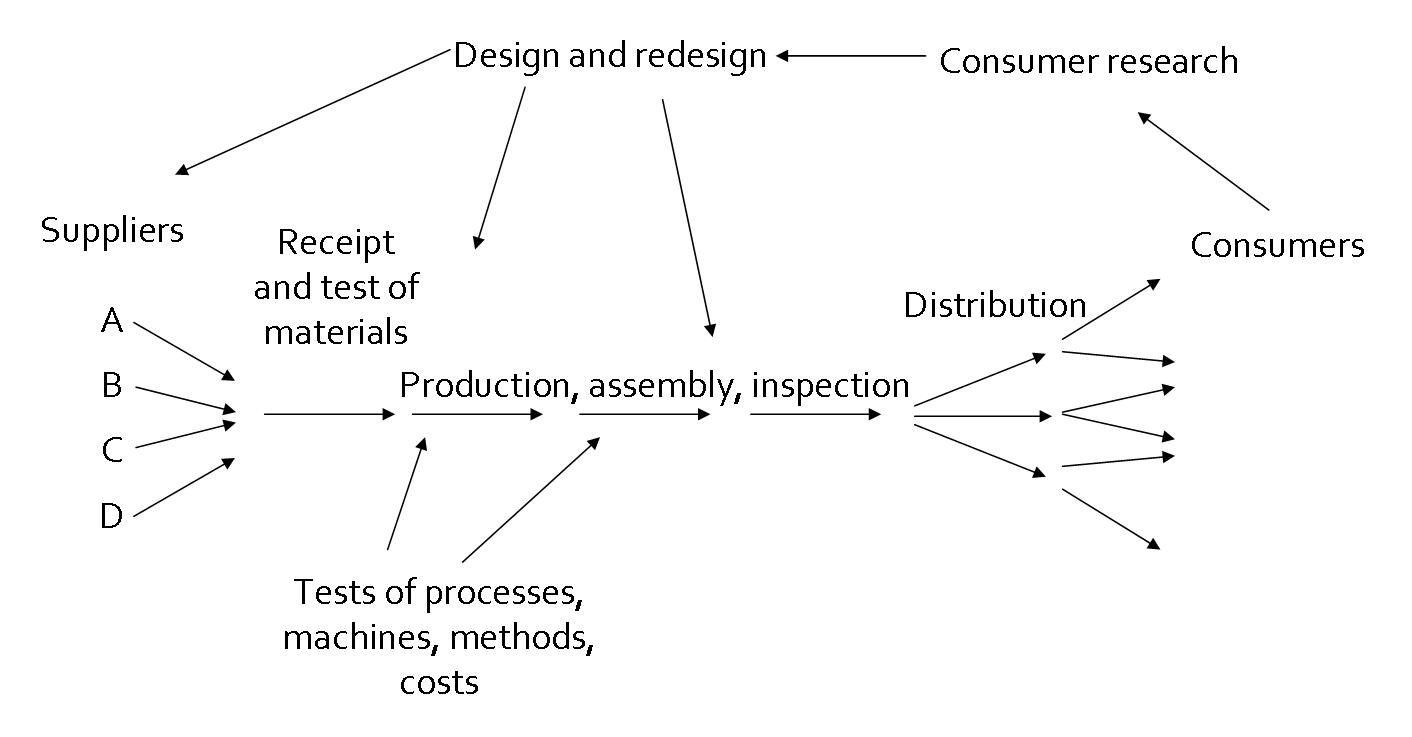
As a leader, how well do you understand how your organization works?  Do you have a good picture of the relationships and interconnections that exist both inside and outside that enable the company to operate?  I’m not sure it’s possible to truly grasp all of the complexities within an operation, but the more a leader understands about the overall system, the more effective improvement efforts will be to reduce waste and improve performance.

W. Edwards Deming wrote about the importance of understanding the system in Out of the Crisis and The New Economics, and what it means to leadership and transformation.  At first glance, it’s easy to miss the significance of the message Deming was trying to convey because of the assumed simplicity of the system diagram he referred to so often.  A common response after first seeing the diagram is, of course an organization consists of processes working together to produce a product or service . . . so what?
Deming's Production Viewed as a System (Out of the Crisis)

Other important aspects of leadership that become evident when systems thinking begins to take hold include:
  • the importance of flow to the success of the organization, as well as some of the areas that impede flow the most;
  • how individual functions tend to work against, rather than with, each other within the system, and how detrimental it is to serving customers;
  • the importance of internal customers and suppliers and how critical it is to improving quality and productivity;
  • a better comprehension of all of the organization’s stakeholders and why they matter to overall success;
  • a much clearer picture of what adds value to the overall system and what does not.
Organizations are in a constant state of change and, although it is not possible to completely understand all of the interrelationships that exist, it is important to appreciate how critical continually improving the interactions is to overall performance.  It also becomes evident that promoting leaders who have this level of appreciation and never stop attempting to learn about and improve the system is important to the company’s long-term success.